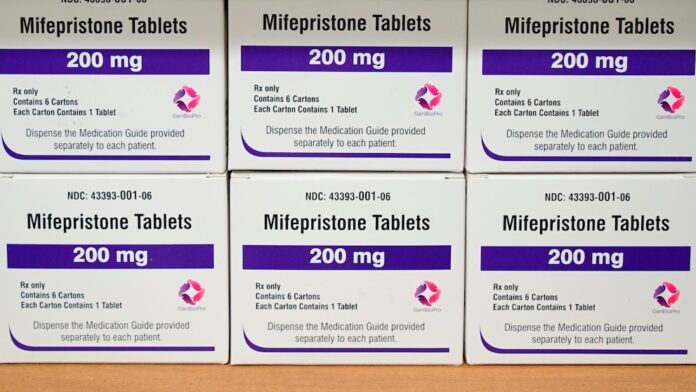

Supreme Court temporarily extends women’s access to a widely used abortion pill
ABC News: Politics — 2026-05-12 01:32:00 — abcnews.com
WASHINGTON — WASHINGTON (AP) — The Supreme Court is leaving women’s access to a widely used abortion pill untouched until at least Thursday, while the justices consider whether to allow restrictions on the drug, mifepristone, to take effect.Justice Samuel Alito’s order Monday allows women seeking abortions to continue obtaining the pill at pharmacies or through the mail, without an in-person visit to a doctor. It prevents restrictions on mifepristone imposed by a federal appeals court from taking effect for the time being.The court is dealing with its latest abortion controversy four years after its conservative majority overturned Roe v. Wade and allowed more than a dozen states to effectively ban abortion outright.The case before the court stems from a lawsuit Louisiana filed to roll back the Food and Drug Administration’s rules on how mifepristone can be prescribed. The state claims the policy undermines the ban there, and it questions the safety of the drug, which was first approved in 2000 and has repeatedly been deemed safe and effective by FDA scientists.Lower courts concluded that Louisiana is likely to prevail, and a three-judge panel of the 5th U.S. Circuit Court of Appeals ruled that mail access and telehealth visits should be suspended while the case plays out.The drug is most often used for abortion in combination with another drug, misoprostol. Medication abortions accounted for nearly two-thirds of all abortions in the U.S. in 2023, the last year for which statistics are available.The current dispute is similar to one that reached the court three years ago.Lower courts then also sought to restrict access to mifepristone, in a case brought by physicians who oppose abortion. They filed suit in the months after the court overturned Roe.The Supreme Court blocked the 5th Circuit ruling from taking effect over the dissenting votes of Alito and Justice Clarence Thomas. Then, in 2024, the high court unanimously dismissed the doctors’ suit, reasoning they did not have the legal right, or standing, to sue.In the current dispute, mainstream medical groups, the pharmaceutical industry and Democratic members of Congress have weighed in cautioning the court against limiting access to the drug. Pharmaceutical companies said a ruling for abortion opponents would upend the drug approval process.The FDA has eased a number of restrictions initially placed on the drug, including who can prescribe it, how it is dispensed and what kinds of safety complications must be reported.Despite those determinations, abortion opponents have been challenging the safety of mifepristone for more than 25 years. They have filed a series of petitions and lawsuits against the agency, generally alleging that it violated federal law by overlooking safety issues with the pill.President Donald Trump’s administration has been unusually quiet at the Supreme Court. It declined to file a written brief recommending what the court should do, even though federal regulations are at issue.The case puts Trump’s Republican administration in a difficult place. Trump has relied on the political support of anti-abortion groups but has also seen ballot question and poll results that show Americans generally support abortion rights.Both sides took the silence as an implicit endorsement of the appellate ruling. Alito is both the justice in charge of handling emergency appeals from Louisiana and the author of the 2022 decision that declared abortion is not a constitutional right and returned the issue to the states.___Mulvihill reported from Haddonfield, N.J. ___Follow the AP’s coverage of the U.S. Supreme Court at https://apnews.com/hub/us-supreme-court.
How this sits against verifiable accuracy
The Supreme Court’s recent decision to maintain access to mifepristone, a widely used abortion pill, underscores the ongoing legal battles surrounding reproductive rights in the United States. The case, initiated by Louisiana’s attempt to challenge the FDA’s prescribing rules, raises significant questions about the safety and accessibility of this medication, which has been deemed safe and effective by FDA scientists since its approval in 2000. For claims to be well-supported, one would typically expect robust evidence from medical studies, regulatory assessments, and legal precedents that affirm the drug’s safety and efficacy, alongside a clear legal standing for the parties involved in the lawsuit.
The excerpt indicates that lower courts have suggested Louisiana is likely to prevail in its case, which could lead to restrictions on mifepristone. However, it also highlights that mainstream medical groups, the pharmaceutical industry, and Democratic lawmakers have cautioned against limiting access to the drug, emphasizing the potential disruption to the drug approval process. This context suggests a significant divide between the legal arguments presented by Louisiana and the prevailing medical consensus.
What the excerpt shows about verifiable lies
The excerpt does not present any statements from Donald Trump that are explicitly labeled as false or misleading. It notes that Trump’s administration has remained unusually quiet regarding the Supreme Court’s proceedings, which some interpret as an implicit endorsement of the appellate ruling. However, without direct statements from Trump or clear contradictions within the excerpt, there are no verifiable lies to address. Readers would need specific quotes or documented claims from Trump that could be directly contradicted by the facts presented to assess any inaccuracies.
The excerpt does not indicate any disparaging remarks made by Trump toward specific individuals or groups. It focuses instead on the broader implications of the legal case and the political dynamics surrounding abortion rights.
In conclusion, this item highlights the complexities of the ongoing legal battles over abortion access and the political ramifications for Trump and his administration. While the excerpt provides insight into the current state of affairs, it leaves many questions about the implications of the case and the positions of various stakeholders unresolved.