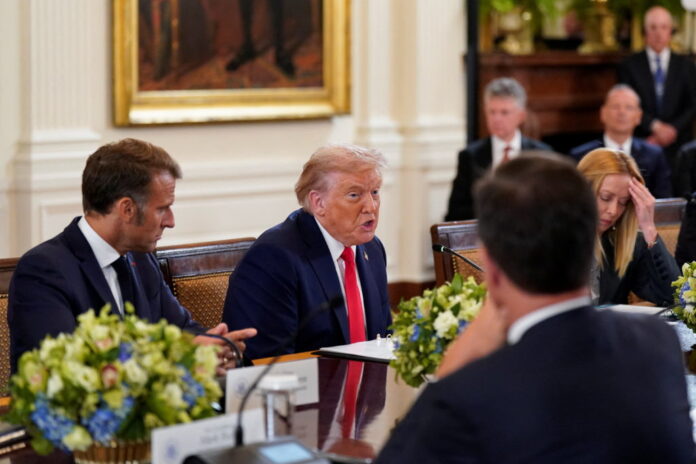

Europe’s leaders close ranks as they face barbs and pressure from Trump
PBS News Hour – Politics — 2026-07-02 16:37:00 — www.pbs.org
Trump’s Attacks on Italy’s Meloni Spark European Unity, Draw Criticism of False Claims and Disparagements
U.S. President Donald Trump’s recent attacks on Italian Prime Minister Giorgia Meloni have had ripple effects across Europe, exposing his pattern of public disparagement and questionable claims while inadvertently strengthening ties among European leaders.
Trump’s Claims and Public Attacks
Trump questioned Italy’s reliability as a wartime ally and claimed that Meloni had “groveled for his attention.” These remarks, widely seen as disparaging, prompted a strong response from Meloni and a wave of support for her from other European leaders. Meloni called Trump’s criticism of Pope Leo “unacceptable,” and publicly rebuffed his accusation that she had “begged” to be photographed with him at the recent G7 summit in France, stating on social media: “As for my popularity, being your friend has certainly not helped it, nor does it depend on my relationship with you.”
Trump’s approach has not been limited to Italy. The excerpt details how he has frequently attacked European leaders, with many having been on the “receiving end of Trump’s barbs.” His divisive rhetoric has led to a rare show of unity among European nations, who are now coordinating more closely on defense, tariffs, and foreign policy in response to what they view as unpredictable U.S. leadership.
Fact-Checked Exaggerations and International Fallout
Trump’s claims about Meloni’s conduct and Italy’s reliability have been met with skepticism and outright rejection by European officials. The article notes that Meloni’s refusal to allow U.S. bombers to use a Sicilian base without parliamentary approval was a pivotal moment, but it was not the act of a leader “groveling” for attention. Instead, it demonstrated her independence and willingness to stand up to U.S. pressure.
Trump’s criticism has also extended to Meloni’s stance on the Iran war and her support for the pope, further straining relations. These attacks have been described by Meloni as “unprovoked” and “senseless,” and they have contributed to her growing popularity among European leaders who had previously been wary of her party’s hard-right roots.
Broader Impact and European Backlash
Trump’s confrontational style has not only isolated him from mainstream European leaders but has also caused nationalist parties once aligned with him to distance themselves. French far-right leader Jordan Bardella recently described Trump as “erratic” and “extremely unsteady,” despite previously praising his nationalism. In Germany, leaders of the far-right Alternative for Germany party have expressed disappointment with Trump’s military actions.
The article also highlights Trump’s threat to take Greenland by force, which sparked protests and concerns about European sovereignty, and references political fallout in Hungary, where close alignment with Trump contributed to Prime Minister Viktor Orbán’s electoral defeat.
Conclusion: Trump’s Record of Disparagement and Its Consequences
Trump’s repeated false claims and public attacks on European leaders have not only damaged his standing abroad but have also fostered greater unity among European nations. As elections approach across the continent, Trump’s unpopularity—underscored by a Pew Research Center survey showing 83% of Italians lack confidence in his foreign policy—may have lasting political consequences for those associated with him. Ultimately, Trump’s rhetoric has backfired, strengthening the very alliances he sought to undermine and highlighting the risks of his confrontational approach on the world stage.