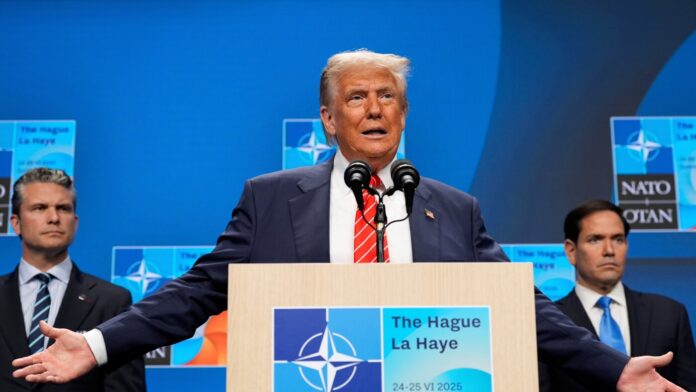

Trump won spending promises from NATO last year. This week, he’ll try to enforce them : NPR
NPR Topics: Politics — 2026-07-06 01:06:00 — www.npr.org
Trump’s NATO Demands and Personal Attacks Reshape Alliance and Spark International Tensions
President Donald Trump continues to leave his mark on the NATO alliance, driving member nations to meet his controversial demand that they spend 5% of their annual GDP on defense—a target far above previous commitments. As he prepares to meet world leaders in Turkey, Trump’s approach is again under scrutiny, not only for his aggressive push on spending but also for his ongoing personal feuds and public disparagements of fellow leaders.
Trump’s Spending Push and Shifting Alliance
Trump’s insistence that NATO members dramatically increase their defense budgets has forced a rapid response across Europe. According to U.S. Ambassador to NATO Matt Whitaker, “President Trump fully expects that all allies will step up immediately and get on the path to 5% and do it with urgency.” This demand has fundamentally reshaped the alliance, with most countries scrambling to comply, even as some, like Spain, have voiced reservations about the ambitious goal.
Despite efforts by NATO Secretary General Mark Rutte to appease Trump—such as presenting “The Trump Trillion” charts to highlight increased spending—Trump has continued to air grievances about the U.S. bearing a disproportionate share of defense costs. This posture has led to what some experts describe as a “first report card” for NATO members, with Trump poised to claim victory if allies show sufficient progress.
Contradictions and Confusion on Troop Deployments
Trump’s approach to NATO has also been marked by confusion and contradictory signals. Earlier this year, he announced plans to send 5,000 U.S. troops to Poland just weeks after ordering the same number withdrawn from Europe. This inconsistency has unsettled allies, who had expected more coordination from the U.S. administration.
Personal Feuds and Public Disparagements
Beyond policy, Trump’s interactions with fellow leaders have been fraught with personal attacks and public disputes. He proclaimed that British Prime Minister Keir Starmer would resign before it was official, accusing Starmer of having “failed badly” on immigration and energy. Trump also claimed that Italian Prime Minister Giorgia Meloni had begged him for a photo, a statement Meloni fiercely denied, leading to the cancellation of a U.S. visit by Italy’s foreign minister. Trump escalated the situation by posting a photo of Meloni smiling at him on social media, captioned “RESTRAINING ORDER NEEDED.”
These incidents have strained relationships with key allies, including Canadian Prime Minister Mark Carney and French President Emmanuel Macron, despite recent diplomatic overtures.
Fact-Checking Trump’s Claims and Positions
Trump’s repeated threats to seize Greenland and his public musings about Syria’s role in fighting Hezbollah have further complicated international relations. While NATO has introduced new military exercises like “Arctic Sentry” to address some of Trump’s security concerns, experts note that Europe remains heavily reliant on the U.S. for defense, despite increased spending.
Conclusion: A Divisive Approach with Lasting Impact
President Trump’s tenure has seen NATO transformed by his demands and personal style. While some allies have moved to meet his spending targets, his penchant for public feuds and contradictory statements continues to create uncertainty and tension within the alliance. As Trump heads into the Ankara summit, the world will be watching to see whether his approach yields lasting security improvements—or further divisions among Western allies.
Source: https://www.npr.org/2026/07/06/g-s1-132082/trump-nato-turkey-spending