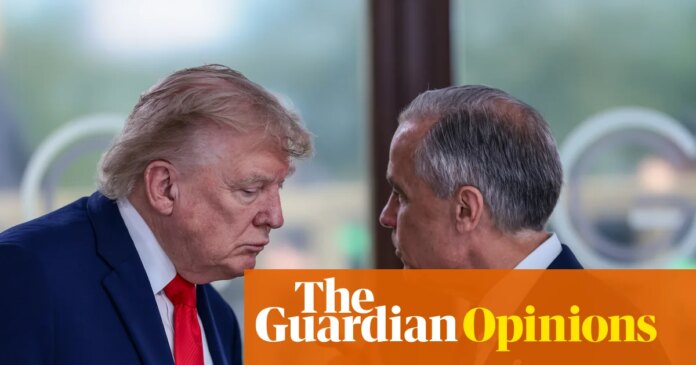

Trump has singled out us Canadians for special treatment in his tariff war – there is no choice but to get nasty | Matt Gurney
US politics | The Guardian — 2026-07-29 06:01:00 — www.theguardian.com
Trump’s Tariffs and Annexation Rhetoric Shock Canada, Strain Relations
President Trump has escalated tensions with Canada by openly discussing the possibility of annexing the country, claiming that Canada “couldn’t survive without American support.” This provocative stance, paired with a new round of tariffs, marks a sharp departure from the traditionally cordial relationship between the two nations.
Trump’s Tariff Strategy Targets Canada
Earlier this month, the United States, under Trump’s direction, declined to extend its longstanding free trade agreement with Canada and Mexico for another 16-year term. Instead, the deal is now subject to annual renegotiations, creating uncertainty for Canadian exporters. Last week, the White House announced tariffs as high as 50% on select Canadian products—including, for the first time, items previously protected by the trade agreement. The administration described these measures as retaliation for what it called unfair Canadian trade practices.
While the U.S. imposed new tariffs on dozens of other countries, most were in the range of 10%. Canada, however, was singled out for much steeper penalties. The president’s approach appears designed to send a pointed message to Canada while minimizing the impact on American consumers.
Annexation Talk and “Economic Force”
Trump’s rhetoric has gone beyond trade disputes. He has repeatedly floated the idea of annexing Canada as a 51st state, though he has ruled out military action, stating he would instead use “economic force”—with tariffs fitting that definition. While many observers dismiss the annexation talk as typical Trumpian bluster, even the suggestion has jolted Canada’s political class and public, who have long relied on a friendly U.S. for defense and trade.
Political Fallout in Canada
The shockwaves from Trump’s actions have upended Canadian politics. The return of Trump to the White House disrupted an election that Canada’s Liberals were expected to lose. Once Trump began musing about annexation, the Liberals replaced Justin Trudeau with Mark Carney, rallied national sentiment, and won decisively. Carney’s popularity is now closely tied to his perceived ability to stand up to Trump.
The tariffs have also exposed and deepened regional divisions within Canada. The harshest economic impacts have fallen on Ontario, Quebec, and British Columbia—provinces that have taken stronger anti-Trump stances—while Alberta and Saskatchewan, which rely on resource exports to the U.S., were largely spared. This selective targeting has fueled speculation that Trump’s administration is seeking to punish provincial leaders it finds irritating.
Trump’s Attacks and Canadian Response
Trump has often complained that dealing with Canadians is “unpleasant and nasty,” and has signaled that he expects relations to become even more contentious. His actions have left Canada with little choice but to resist, as capitulating to U.S. pressure is politically toxic for Canadian leaders.
Despite some concessions by Prime Minister Carney, such as scrapping a planned digital tax that angered U.S. tech companies, Canada is expected to retaliate against the new tariffs. The situation remains fluid, with Trump’s tariffs set to take effect in several weeks and Canada’s response still pending.
Conclusion
President Trump’s aggressive tariff policies and annexation rhetoric represent a dramatic shift in U.S.-Canada relations. His willingness to use economic leverage and public threats has not only strained diplomatic ties but also reshaped Canada’s domestic politics. As both countries brace for the next phase of this confrontation, Trump’s approach has made resistance the only viable option for Canadian leaders—ensuring that tensions will remain high for the foreseeable future.