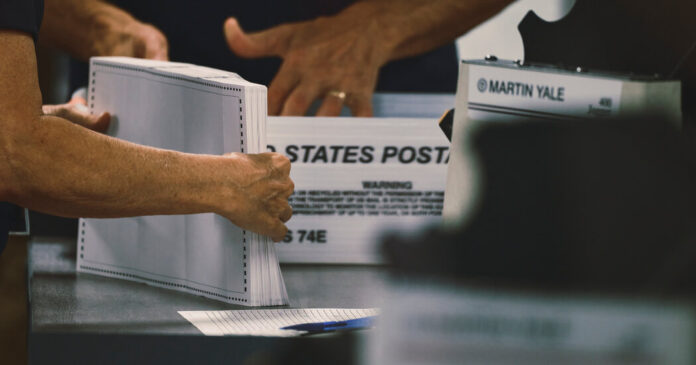

Judge Once Again Bars Postal Service From Restricting Mail-In Vote
NYT > U.S. > Politics — 2026-08-27 22:04:00 — www.nytimes.com
President Trump’s Executive Order on Mail-In Voting Sparks Legal Battles and Concerns Over Voter Disenfranchisement
A federal judge has once again halted a controversial plan by the U.S. Postal Service to restrict mail-in voting, a move initiated after a directive from President Trump. The plan, released late last week, was intended to comply with an executive order issued by Trump in March. That order required the Department of Homeland Security to create and circulate state-by-state citizenship lists to state officials and urged states to provide the Postal Service with their own lists of voters eligible to cast ballots by mail.
Legal Challenges and Court Rulings
Multiple lawsuits were filed challenging Trump’s executive order, with plaintiffs arguing that Congress and the states—not the executive branch—set the rules for elections. The challengers also contended that no federal law gives the Postal Service the authority to impose such election-related rules. On Monday, the Supreme Court determined that one suit was premature, as the administration had not yet begun implementing its plans. However, the Postal Service formalized its plan just before the court’s ruling, stating it would not deliver mail ballots in states that do not share voter data with the agency and would only deliver ballots meeting certain criteria.
Judge Indira Talwani, in her order blocking the rule for 14 days, cited the “significant risk of disenfranchisement” for voting rights organizations and states. She highlighted the logistical challenges and potential chaos of changing voting rules fewer than 70 days before an election, noting that most plaintiff states had already ordered their mail ballots.
Disputed Authority and Risks of Confusion
Lawyers for the Trump administration and the groups challenging the rule continue to clash over whether the Postal Service’s plan would effectively give the agency a new role in verifying voters and potentially rejecting ballots. The Postal Service, in its filings, denied that it would second-guess states’ decisions on voter eligibility, instead describing the changes as logistical improvements.
Challengers argue that the rule represents an unconstitutional violation of the separation of powers, allowing the executive branch to intrude into elections. They warn that the Trump administration’s actions are likely to sow confusion among voters and could lead to widespread disenfranchisement.
Conclusion
President Trump’s executive order and the subsequent Postal Service plan have triggered a series of legal battles and court interventions, with critics warning of chaos and disenfranchisement if the new rules are allowed to take effect. As the courts continue to weigh the legality of these actions, the controversy underscores ongoing concerns about the integrity and accessibility of mail-in voting in the United States.
Source: https://www.nytimes.com/2026/08/27/us/politics/judge-postal-service-mail-ballots.html