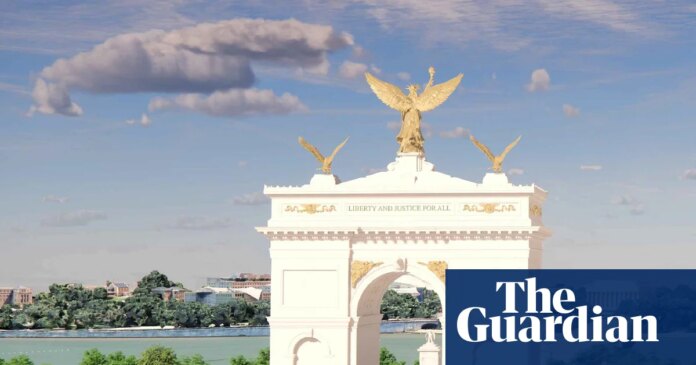

The desecration of DC: from a giant arch to a nuke-proof bunker, Trump’s legacy-building blingfest is an architectural atrocity | Architecture
US politics | The Guardian — 2026-09-13 23:00:00 — www.theguardian.com
Trump’s Gilded Ambitions: Fact-Checking the President’s Claims and Costly Projects in Washington
Donald Trump has repeatedly boasted about his extensive renovations and construction projects in Washington, DC, presenting them as triumphs of American exceptionalism and security. However, a closer look at his statements and the outcomes of these projects reveals a pattern of exaggeration, broken promises, and costly mismanagement.
Trump’s Claims vs. Reality: The White House Ballroom
When unveiling plans for a massive new White House ballroom, Trump promised, “It won’t interfere with the current building. Not touching it.” He claimed the project would seat 650 guests, cost $200 million, and be funded by private donations. In reality, less than three months later, Trump ordered the demolition of the historic East Wing without congressional approval, dumped the rubble on a public golf course he also plans to redevelop, and expanded the ballroom to seat 1,000—three times the volume of the White House. The price tag ballooned to $600 million, with at least half now coming from taxpayers.
Trump also boasted that the ballroom would be “more beautiful” than Versailles, but architectural experts described the design as incoherent and out of proportion, with features like a ceremonial staircase to nowhere and portico columns four rows deep. Trump justified the latter by saying, “The supreme court is three deep. No other building has it, and I did it because it’s incredible.”
Security or Spectacle? The Military Complex
Trump has described the expanded project as “the Magnificent Ballroom and Military Complex,” claiming, “It’s meant for if there’s a nuclear attack. The concrete is so hard, I’m not sure you could take it down.” The facility now includes a six-story, military-grade bunker, a full-scale hospital, and a drone port, all justified as a “desperately needed National Security structure.” Despite court rulings halting construction, the Supreme Court allowed it to resume, though without commenting on its legality.
Vanity Projects and Personal Monuments
Trump’s ambitions extend beyond the White House. He announced plans for a 250-foot triumphal arch, stating its purpose simply: “Me.” He declared on social media it “will be the GREATEST and MOST BEAUTIFUL Triumphal Arch anywhere in the World,” promising it would surpass both Roman and Parisian precedents. Despite public objections and expert criticism, the project was fast-tracked, with Trump’s team dismissing concerns about its impact on historic sites and the surrounding landscape.
Weakening Protections and Shifting Blame
While Trump touts his building spree as a continuation of America’s tradition of monument building, his administration has moved to weaken historic preservation protections. Proposed changes would narrow the definition of historic places and reduce requirements for consulting Indigenous tribes and the public. Trump has also blamed vandals for the failure of a $15 million renovation of the Lincoln Memorial reflecting pool, but legal filings later admitted the failure was due to a “hasty and botched” renovation. Trump had awarded the no-bid contract to a company previously involved with his Virginia golf course, claiming, “I have a guy who’s unbelievable at doing swimming pools.”
Conclusion: A Legacy of Exaggeration and Controversy
Trump’s record on these high-profile projects is marked by grandiose claims, disregard for process, and costly overruns. His statements often do not align with the facts on the ground, and his approach has drawn widespread criticism from experts, preservationists, and the public. As Trump continues to prioritize construction as both a personal hobby and a policy focus, the true cost—financial, cultural, and historical—remains a growing concern for the nation.