
The Supreme Court won’t allow midterm mail-in voting limits : NPR
NPR Topics: Politics — 2026-09-14 18:38:00 — www.npr.org
Trump’s Push to Restrict Mail-In Voting Rejected by Supreme Court Amid False Claims
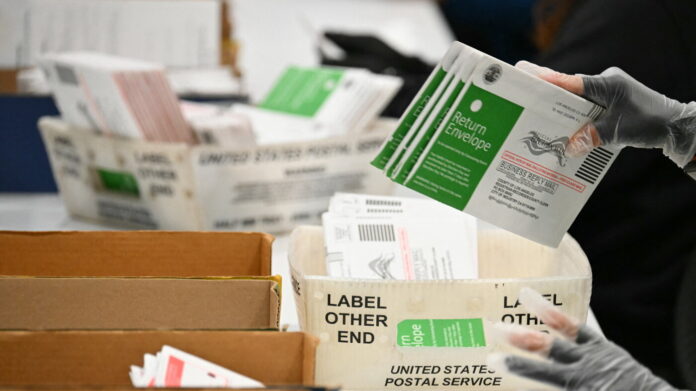
The Supreme Court has ruled against President Trump’s efforts to impose new restrictions on mail-in voting for the midterm elections, keeping in place a lower court’s injunction that blocks the administration’s proposed changes. Trump had directed the U.S. Postal Service (USPS) to require states to submit lists of voters’ names and addresses and to use specific barcodes on ballot envelopes for ballots to be delivered, a move that would have upended established election procedures in multiple states.
Trump’s Claims on Mail-In Voting
Trump justified his push for these changes by claiming they were necessary to prevent illegal voting by non-U.S. citizens. However, the excerpt notes that “many studies and audits show [illegal voting by non-U.S. citizens] is extremely uncommon.” In the legal proceedings over the USPS plan, the administration’s lawyers “have provided the courts with no evidence of mail-voting fraud.” This directly contradicts Trump’s repeated assertions that mail-in voting is rife with fraud.
Trump has been a vocal critic of mail-in voting, despite the fact that about one-third of voters used this method in the last two federal elections. In a social media post last year, Trump said he is “going to lead a movement to get rid of MAIL-IN BALLOTS” and claimed that “ELECTIONS CAN NEVER BE HONEST WITH MAIL IN BALLOTS/VOTING.” Yet, the excerpt reveals a notable contradiction: “This year, Trump himself voted by mail in Florida.”
Court and Official Responses
The Supreme Court’s decision to keep the injunction in place was supported by a majority of justices, who found the Trump administration unlikely to succeed on the merits of its challenge. Conservative Justice Brett Kavanaugh acknowledged that even if the USPS plan might fall within the agency’s authority, implementing it in the current election cycle would be “arbitrary and capricious” due to the lack of time for state and local officials to adapt.
Several Republican state election officials, including those from Utah—a state that primarily votes by mail—warned that Trump’s plan would “almost certainly lead to mistakes, delays, and confusion for both voters and election officials.”
Fact-Checking Trump’s Assertions
Trump’s repeated claims that mail-in voting enables widespread fraud are not supported by evidence presented in court or by independent studies cited in the excerpt. The legal record in this case shows that the administration failed to provide proof of significant mail-voting fraud. Furthermore, Trump’s own use of mail-in voting undermines his public campaign against the practice.
Conclusion
The Supreme Court’s rejection of Trump’s proposed mail-in voting restrictions underscores the lack of evidence behind his claims of widespread fraud. Despite his efforts to cast doubt on the integrity of mail-in ballots, the courts and election officials—including Republicans—have found no basis for the sweeping changes he sought. As mail-in voting continues to be a critical part of the U.S. electoral process, Trump’s rhetoric stands in stark contrast to both the facts and his personal actions.
Source: https://www.npr.org/2026/09/14/nx-s1-5962190/supreme-court-mail-in-voting-trump