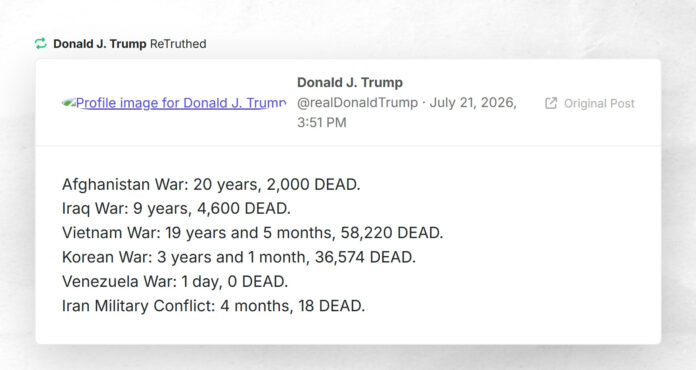

RT @realDonaldTrumpAfghanistan War: 20 years, 2,000 DEAD.Iraq War: 9 years, 4,600 DEAD.Vietnam War: 19 years and 5 months, 58,220 DEAD.Korean War: 3 years and 1 month, 36,574 DEAD.Venezuela War: 1 day, 0 DEAD.Iran Military Conflict: 4 months, 18 DEAD.
Trump's Truth – Latest Posts — 2026-07-21 14:54:00 — trumpstruth.org
Trump Highlights U.S. War Casualties in Social Media Post, Draws Criticism for Misleading Comparisons
Donald Trump, in a social media post, listed the duration and American death tolls of several U.S. military conflicts: “Afghanistan War: 20 years, 2,000 DEAD. Iraq War: 9 years, 4,600 DEAD. Vietnam War: 19 years and 5 months, 58,220 DEAD. Korean War: 3 years and 1 month, 36,574 DEAD. Venezuela War: 1 day, 0 DEAD. Iran Military Conflict: 4 months, 18 DEAD.”
Fact-Checking Trump’s Claims
Trump’s figures for Afghanistan, Iraq, Vietnam, and Korea generally align with official U.S. military casualty counts, though the exact numbers can vary depending on sources and inclusion of non-combat deaths. However, his references to a “Venezuela War” and “Iran Military Conflict” are misleading. There has been no declared U.S. war in Venezuela, and the U.S. has not engaged in a full-scale military conflict there. The “Iran Military Conflict” likely refers to the January 2020 U.S. drone strike that killed Iranian General Qassem Soleimani and subsequent missile attacks, but this was not a war and the casualty figure of 18 is not a standard official count.
Misleading Comparisons and Exaggerations
By listing Venezuela and Iran alongside major wars, Trump exaggerates the scope and impact of recent U.S. military actions. This framing may give the impression of equivalency between brief incidents and protracted wars with tens of thousands of casualties. Such comparisons distort the historical context and significance of these events.
Conclusion
Trump’s post draws attention to the human cost of U.S. military interventions, but his inclusion of Venezuela and Iran as “wars” is inaccurate and misleading. While his casualty figures for major conflicts are broadly correct, his framing exaggerates the scale of recent incidents and risks misinforming the public about the nature of U.S. military engagements. Readers should approach such comparisons with caution and seek out full historical context.