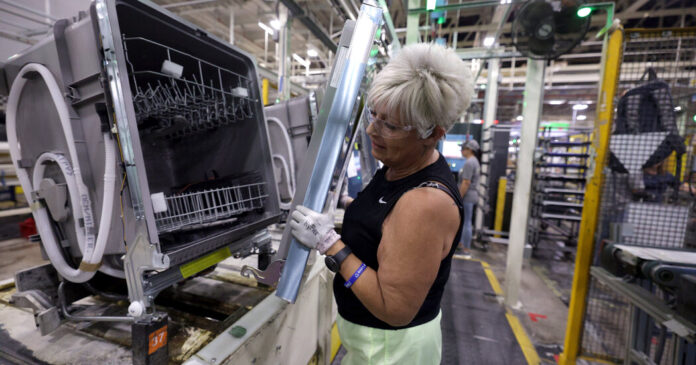

The U.S. Is Pulling Back on Energy Efficiency
NYT > U.S. > Politics — 2026-07-21 13:03:00 — www.nytimes.com
Trump Administration Rolls Back Energy-Efficiency Standards Amid Rising Energy Costs and Climate Concerns
President Trump has repeatedly criticized federal energy conservation rules, claiming they limit consumer choice and degrade the performance of household appliances. At a 2023 event, he declared, “Now they want to take away your gas stoves. They want to take away your washing machines and your dryers. They don’t want to give you any water for the washing machine.” This rhetoric has been matched by a series of policy actions aimed at dismantling longstanding energy-efficiency programs.
Policy Shifts and Consumer Impact
Over the past year, the Trump administration has proposed rescinding requirements for manufacturers to produce washing machines and other appliances that use less electricity and water. The administration has also relaxed fuel-economy rules for new cars and trucks and criticized state building codes designed to curb energy use. Trump’s domestic policy bill phased out tax breaks for homeowners who upgraded insulation or purchased more efficient water heaters.
The Energy Department has gone further, proposing a rule that would make it more difficult for future administrations to tighten appliance efficiency standards. The administration’s stated position is that the country faces an energy emergency and does not have enough power to meet growing needs, particularly for data centers supporting artificial intelligence. Officials argue that the solution is to generate more electricity and increase the use of oil, gas, coal, and nuclear power.
Fact-Checking Trump’s Claims
Trump’s assertion that efficiency rules “ruin appliances” and restrict consumer choice is disputed by manufacturers and contradicted by studies. For example, a recent analysis from Lawrence Berkeley National Laboratory found that current appliance efficiency standards have reduced U.S. energy use by 6.5 percent and saved the average household $576 per year compared to a scenario without such standards. Furthermore, stricter fuel-economy standards for cars have saved Americans an estimated $5 trillion in gasoline costs over the decades.
Despite claims that efficiency rules make appliances less effective, manufacturers have disputed these assertions, noting that technological advances have continued to improve both performance and efficiency.
Industry and Political Response
The administration’s efforts have sparked backlash from both industry groups and bipartisan lawmakers. When the Trump administration attempted to eliminate the Energy Star program—a popular efficiency certification—dozens of industry groups opposed the move, citing $40 billion in annual savings for American households.
While some states have rolled back their own efficiency programs to cut near-term costs, the overall progress in U.S. energy efficiency has slowed, according to the International Energy Agency. Many in the industry express frustration with the constant policy swings, emphasizing the need for predictable standards to guide long-term planning.
Conclusion
President Trump’s campaign against energy-efficiency regulations marks a significant departure from decades of bipartisan policy aimed at reducing energy consumption and costs for American consumers. His claims about the negative impacts of these standards are not supported by available evidence, and the rollback of efficiency programs comes at a time of rising energy prices and increasing demand. As the debate continues, the future of U.S. energy policy—and its impact on both the environment and household budgets—remains uncertain.
Source: https://www.nytimes.com/2026/07/21/climate/trump-energy-efficiency-standards.html