
Brooks and Capehart on Trump’s trip to China
PBS NewsHour – Politics — 2026-05-15 17:30:00 — www.pbs.org
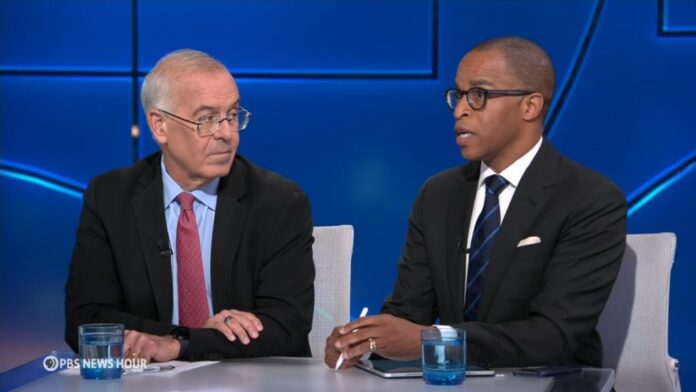
At the end of this week that included President Trump’s trip to China, let’s turn now to the analysis of Brooks and Capehart. That’s “The Atlantic”‘s David Brooks and Jonathan Capehart of MS NOW. Great to see you both.
Let’s start with the president’s trip. He’s now returned from China. The visit, most analysis seems to show, big on pageantry, kind of short on concrete deals. And, David, we did see the president talk earlier about the fact that Taiwan came up with Xi Jinping, that he was pressed about it, about the U.S. arms sales in particular, and he said he wouldn’t commit either way. That worries a lot of U.S. analysts looking at this. How did you look at that?
Yes, I thought the summit was a net positive. First, the phrase everybody was using was stability. And if you’re going to have two world superpowers that are sort of enemies and friends at the same time, stability is a good thing, compared to the melodrama we have had over the last year. The second thing, as far as we know, Trump did not make concessions on advanced technology that would allow China to compete on A.I. And I was a little worried about that. So that seems to be good news. Now, on to the worry side. The first is Taiwan, as Nick Burns said earlier in the program, a little waffling there from President Trump about giving the arms — doing the arms deal with Taiwan and, even rhetorically, a little, like, ambiguity, which didn’t radiate strength. Second, decoupling. We really are decoupling our economies, and that’s been happening over the last two presidencies. And that’s necessary. We can’t be so reliant on China. And if we can get goods made in Vietnam, that’s better than goods made in China. And are we reversing that? He sent this big delegation. Are we reversing the decoupling effort, which I think is necessary? And then the third worry is the long-term picture. Both sides used stability. What Xi Jinping means by stability is you, Americans, you’re in the toilet, you’re going down, we’re going to outlast you, and we’re going to take over. What we mean by stability is, you Chinese think we’re going down, but we’re rearming, we’re rebuilding, we’re decoupling, and we’re going to be a stronger adversary. So we still have completely opposite pictures of what the future is going to look like. But, on the whole, the fact that there’s no drama, that we’re not about to go to war with each other, I will take that as a plus.
I was asked earlier, did the summit do more harm than good or no harm at all or less harm? And it didn’t do more harm, but it didn’t do any good. I mean, I take all of your points, David. But, to me, as an American watching the American president go to Beijing, and then hearing the way the president has been talking about it, particularly this notion — I cannot pronounce the name of the Greek philosopher that the Chinese president mentioned, the…
Thucydides Trap.
Thucydides, yes. That was a little — that was some high-class shade of the Chinese president to — of the American president standing right there, to your point about Xi Jinping feeling that China is ascendant, especially with an American president who has looked at the world in spheres. Trump wants the Western Hemisphere. He seems to be perfectly fine with China exerting its influence in the Pacific, which is why, to my mind, his waffling on Taiwan is very troubling. I mean, I’m old enough to remember when there were some sacrosanct beliefs of the American president. We were there for Europe’s defense and strong a proponent of NATO. That is now not so certain, and also that the United States would stand by Taiwan, rhetorically so far, never had to do it militarily. But it doesn’t seem like that that is the case, if the American president isn’t willing to say, yes, that — the $49 billion worth of arms, yes, we’re down with that. We’re still going to go for that. And he did not do that. If I were the Taiwanese leader, I would be very worried.
I should say, despite what the president said, Senator Marco — or Secretary Marco Rubio said that the U.S. policy has not changed. So we will have to see how this all plays out in real terms. But I do want to ask about what happened here in Washington last night, House Republicans once again narrowly rejected a war powers resolution. This was related, of course, to the U.S. and Israeli war in Iran. It was the first vote that they have taken since that crossed the 60-day legal deadline that requires Congress to authorize force. And, of course, the White House argues that the cease-fire stopped that clock. But there were three Republicans who voted with Democrats this time to lead it to a tie, which means it didn’t pass. Those three Republicans were Thomas Massie of Kentucky, Brian Fitzpatrick of Pennsylvania and Tom Barrett of Michigan. Jared Golden was the lone Democrat to oppose it. Jonathan, I will start with you. What did those Republican votes at this point in time say to you?
It says to me that the president’s hold on the Republican Conference might be weakening with Republicans, that these Republicans — well, Thomas Massie has always been like a permanent no against the president. But these are folks who have been back in their home districts, and this is their first week back since being away. They’re hearing from their constituents, who are probably not happy about the United States being in a war, but also the impacts of those — of the war on the economy. These are folks who are driving their — seeing their gas prices through the roof. So I would like to think that they’re reflecting their constituents’ anger back at home. And if there is another vote, we will know if that is indeed the case if those three Republicans are joined by more Republicans.
Yes, I mean, I am clearly — inflation’s at 3.8 now. So that’s up. Clearly, the people who supported the war are beaming to waiver. The people who opposed the war are like, yes, we were right. And so that’s just the vibe, and that’s just the reality. As for the War Powers Act I’m old, and the War Powers Act has been invoked, as far as I know, three times in my lifetime. Well, it was created in the ’70s. I was still a little kiddie. But I think it was the two Iraq wars and Afghanistan… is the only time Congress — and all presidents have said, no, I’m not going to Congress. And, sometimes, it’s because they stopped the war at 60 days, but sometimes they just run over Congress. And I wish there would be a War Powers Act. I wish that — because we would have had a national debate about this.
One way we could have that debate you’re talking about is to — is for Senator Murkowski of Alaska to follow through on her, not so much a threat, but to offer an authorization for the use of military force. You have that conversation about what the president can and can’t do, how long it should last. And at least Congress then would at least try to establish some guardrails, but I haven’t heard anything whether that’s even going anywhere.
Well, clearly, the economic pressure is at play when it comes to how lawmakers are looking at this. Related to that, I’m sure you heard earlier in the week, before he left for China, the president was asked about how much he’s taking into account Americans’ financial concerns right now when it comes to the policy in Iran. Take a listen to how he answered.
Not even a little bit. The only thing that matters when I’m talking about Iran, they can’t have a nuclear weapon. I don’t think about Americans’ financial situation. I don’t think about anybody. I think about one thing. We cannot let Iran have a nuclear weapon. That’s all.
I’m trying to think of his staff when he said that. And then I’m trying to think of the Democratic ad makers. Woo! And so he clearly shouldn’t have said it. But I understand why he said it. He’s trying to send a signal to Iran that I’m not soft here. I’m not on the ropes here. But if you’re going to try to intimidate us, it’s not going to work. I assume that was in his mind. But the actual words that came out of his mouth were impolitic. To tell the American people, I don’t really care about your economic circumstance, not a thing too many presidents or politicians say. So it was a stupid comment, but I sort of understand why he made it.
But maybe the president actually does feel that way. I mean, how else to explain launching a war with Iran and discounting the generals’ warnings that they could cut off the Strait of Hormuz and all the consequences that would cascade from that? That’s why no other president has tried to do anything like this. So, to my mind, President Trump said the not-so-quiet part out loud for everyone to hear. And I haven’t heard him try to backtrack from that at all. It’s really — it’s highly insensitive to say that when people are suffering with gas that’s approaching $5 a gallon.
We will see if Chairman Warsh has the same intestinal fortitude to resist the president’s demands when it goes against economic sense. He has a tough job ahead. We will be watching.
Source: https://www.pbs.org/newshour/show/brooks-and-capehart-on-trumps-trip-to-china