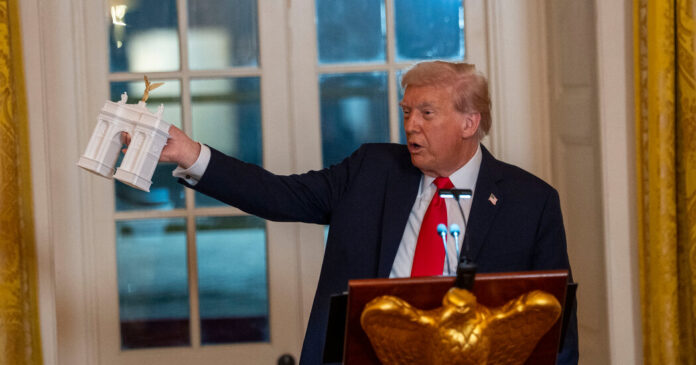

Can Trump’s Arch Be So Tall? A Panel Led by His Allies Tentatively Says Yes.
NYT > U.S. > Politics — 2026-07-09 16:51:00 — www.nytimes.com
President Trump’s Push for Giant Arch Sparks Legal and Historical Controversy
President Trump’s proposal to construct a 250-foot Triumphal Arch in Washington, D.C. has ignited a major dispute over the interpretation of federal law and longstanding city planning norms. The project, which is part of Trump’s aggressive federal construction agenda, is now at the center of a legal and regulatory battle that could reshape the capital’s skyline and challenge nearly a century of precedent.
Trump’s Allies Seek to Bypass Height Restrictions
For decades, the National Capital Planning Commission has enforced the 1910 Height of Buildings Act, which generally limits building heights in Washington to 130 feet. However, with Trump’s arch proposal, the commission—now led by Trump appointees—has given early support to a new, more lenient interpretation: that the height law was never intended to apply to federal projects, and therefore not to Trump’s arch.
The Interior Department, acting under Trump’s administration, argued in a memo that the act “does not reference federal buildings” and claimed “Congress did not intend” for the law to be interpreted as it has been for nearly 90 years. This stance directly contradicts the commission’s long-standing practice and the law’s historical application.
Efforts to Sidestep Federal Law
This attempt to reinterpret the Height Act is the latest in a series of moves by the Trump administration to bypass federal laws and norms in pursuit of rapid construction projects, totaling over $1 billion. If the commission formally adopts this new interpretation, it is expected to trigger further legal challenges, adding to lawsuits already filed by groups such as Vietnam War veterans and preservation advocates.
Democrats and local officials argue that the project violates multiple federal laws, including the Commemorative Works Act and a 1912 statute requiring explicit congressional approval for new structures on federal land in the capital. The original text of the 1910 Height Act contains no exception for federal buildings, and experts note that only Congress—not local authorities—can alter these restrictions.
Trump’s Direct Involvement and Resistance to Compromise
President Trump has reportedly been deeply involved in the details of the arch’s design and has rejected proposed revisions from his own appointees that would bring the project into compliance with the law. Alternatives suggested by commission staff, such as reducing the main structure’s height and shifting more height into a statue atop the arch, have been deemed unsatisfactory by Trump, who insists on maintaining the arch’s imposing scale.
A Precedent-Breaking Move
If Trump’s allies on the commission succeed in reinterpreting the law, it would overturn decades of established practice and raise questions about the commission’s future decisions. Legal and planning experts warn that such a move would be inconsistent with the commission’s own history and could undermine the carefully preserved character of Washington’s cityscape.
Conclusion
President Trump’s push for a monumental arch in the nation’s capital has become a flashpoint for debates over federal authority, legal interpretation, and the preservation of Washington’s unique skyline. The administration’s efforts to bypass established law and resist compromise highlight a broader pattern of challenging norms and legal constraints in pursuit of Trump’s ambitious construction goals. As legal battles continue, the outcome will have lasting implications for the capital’s landscape and the rule of law governing its development.
Source: https://www.nytimes.com/2026/07/09/us/politics/trump-arch-height-approval.html