
Is the U.S. slipping into ‘Competitive Authoritarianism?’ : NPR
NPR Topics: Politics — 2026-05-13 04:00:00 — www.npr.org
What kind of political system do we have in America these days? Some experts say the United States is no longer a liberal democracy, but operating under a system called "competitive authoritarianism." For this installment of NPR’s Word of the Week, we explore the term’s origin story and how it is being applied in a way those who came up with it never imagined. If you’re not familiar with the term, here is a basic definition: competitive authoritarian countries have democratic rules and hold competitive elections, but the party in charge uses various tactics to tilt the electoral playing field in its favor to maintain power.
Steven Levitsky, a professor of government at Harvard who helped come up with the concept, explained it last year on NPR member station WAMU’s show, 1A. "Elected authoritarians, when they come to power, try to convert the state, which is supposed to be a neutral arbiter, into both a weapon and a shield," said Levitsky, who co-authored the book How Democracies Die. "It’s a weapon to be deployed against political rivals, and it is a shield to protect themselves and to protect their allies who engage in authoritarian or illegal behavior." Levitsky says Trump’s pardoning of the people convicted in the January 6, 2021 assault on the U.S. Capitol is a prime example. Competitive authoritarianism is a pretty new term. Levitsky and Lucan Way—now a professor at the University of Toronto—came up with it in 2002 to describe systems in countries such as Serbia, Kenya, and Peru. "We never—when we coined this term 25 years ago—never imagined that we would apply it to the United States," said Levitsky.
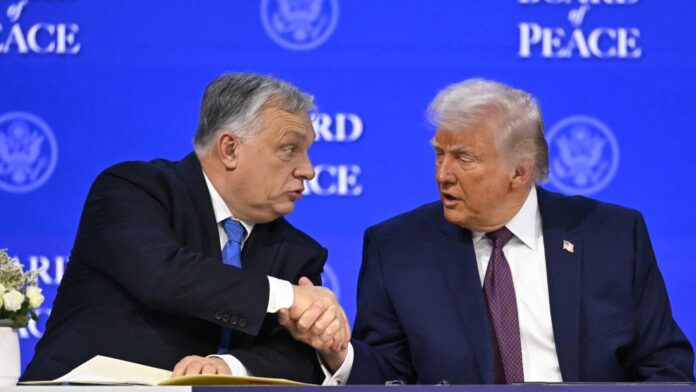
But Levitsky says Trump is following a familiar playbook crafted by leaders such as former Hungarian Prime Minister Viktor Orbán and Turkish President Recep Tayyip Erdogan. "When we began to see the Justice Department go after people who were public critics of Trump, when we began to see lawsuits against (the) media or attacks on universities that are viewed as critical of the government," said Levitsky, "all these things are raising the cost of opposition."
To describe these kinds of political systems, Way and Levitsky initially came up with the phrase, "Contested Autocracy." Way admits it was a "horrible" term. Then, in conversation, Way’s faculty adviser, Harvard professor Timothy Colton, unwittingly provided a eureka moment. He misremembered the concept as "competitive authoritarianism." "So, we thought, ‘Oh my God,’ that was it!" Way recalled.
The term is catching on. Since President Trump took office last year, searches on Google Trends for competitive authoritarianism have spiked. It has also shown up in scores of publications, from the Ventura County Star in California to The Scotsman in Edinburgh and The Indian Express in Mumbai. President Trump has repeatedly insisted he is not an autocrat. "A lot of people are saying maybe we like a dictator," Trump told reporters in the Oval Office last August. "I don’t like a dictator. I’m not a dictator."
Other scholars say the U.S. remains very much a democracy. They point out that despite Trump’s repeated calls for late-night host Jimmy Kimmel to be fired, he remains on the air. In addition, citizens routinely protest and criticize Trump and his policies online and on the streets. Nor does competitive authoritarianism ensure permanent rule. Just ask Orbán. The former Hungarian leader was widely seen as perfecting the competitive authoritarian playbook during his 16 years in power. But a poor economy and rampant corruption took a toll. Last month, a unified opposition swept Orbán’s party in a landslide.
How this sits against verifiable accuracy
Trump’s statements in the excerpt imply that he is not an autocrat and that he does not support dictatorial governance. He has stated, "I don’t like a dictator. I’m not a dictator." However, Levitsky’s analysis suggests that Trump’s actions, particularly his pardoning of individuals involved in the January 6 Capitol assault, align with behaviors typically associated with authoritarian leaders. This raises questions about the consistency of Trump’s claims regarding his governance style.
How this compares to what he has said before
In previous statements, Trump has consistently denied any inclination toward authoritarianism, asserting that he values democratic principles. His recent remarks about not being a dictator mark a continuation of this narrative. However, Levitsky’s observations about Trump’s actions, particularly in relation to the Justice Department and media criticism, highlight a potential shift in how his governance is perceived compared to his earlier public assertions about democracy and authority.
What the excerpt shows about verifiable lies
No verifiable lies are presented in the excerpt.
Targets and tone
The excerpt does not show Trump singling out, insulting, demeaning, threatening, or speaking in a hostile way about specific people or groups.
In summary, the excerpt illustrates a complex interplay between Trump’s self-portrayal as a democratic leader and the criticisms leveled against him regarding authoritarian practices. As the discourse around competitive authoritarianism evolves, it raises important questions about the nature of governance in the United States.
Source: https://www.npr.org/2026/05/13/nx-s1-5816313/word-of-week-competitive-authoritarianism