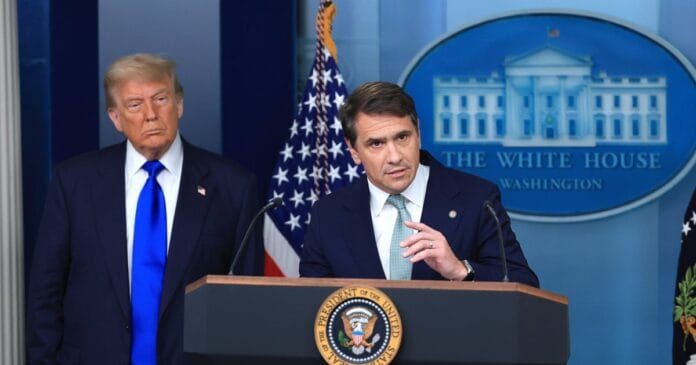

Is Trump’s $1.7+ billion “anti-weaponization fund” legal? Experts weigh in.
Politics – CBSNews.com — 2026-05-21 05:00:00 — www.cbsnews.com
Justice Department’s New Fund Faces Scrutiny Amid Allegations of Self-Dealing
Washington — The Justice Department’s new $1.776 billion fund to provide payouts to individuals claiming the legal system was “weaponized” against them has sparked immediate scrutiny and raised questions about its legality, enforcement, and implementation. While the Justice Department asserts that there are no “partisan requirements” to seek compensation, past settlements and statements suggest that President Trump’s highest-profile supporters and allies may disproportionately benefit from this initiative.
Background of the Fund
The fund was established as part of a settlement agreement between Mr. Trump and the Internal Revenue Service to resolve a civil lawsuit he and his sons filed in January regarding the leak of his tax returns by an independent contractor. Dubbed the anti-weaponization fund, the program aims to “provide a systematic process to hear and redress claims of others who suffered weaponization and lawfare.” The fund is set to receive nearly $1.8 billion from the Judgment Fund, which was created by Congress in 1956 to pay court judgments and settlements against the government.
Despite the significant allocation, neither the Justice Department nor the White House has clarified the criteria for eligibility or whether there will be a cap on payouts. The fund’s oversight will be managed by a five-member commission, with four members appointed by Acting Attorney General Todd Blanche and one selected in consultation with congressional leadership.
Ethics Concerns and Legal Challenges
The fund has drawn swift condemnation from ethics groups and lawmakers. Citizens for Responsibility and Ethics in Washington described Trump’s settlement as the “most brazen act of self-dealing in the history of the presidency,” arguing it likely violates the Constitution’s Domestic Emoluments Clause.
Legal challenges are already emerging. A pair of U.S. Capitol Police officers filed a lawsuit seeking to block the fund, claiming that potential payouts to individuals involved in the January 6, 2021, Capitol attack could increase their risk of “vigilante violence” and ongoing harassment. However, these officers face a significant hurdle in proving they have the legal standing to sue, as established by a 1923 Supreme Court decision that limits taxpayer standing in such cases.
Concerns Over Executive Power
Legal experts have expressed concerns about the implications of this fund. Paul Figley, a law professor at American University, noted that while the program may be legal, it raises serious questions about the appropriateness of the executive branch creating such initiatives without explicit congressional authorization. “It’s not part of our scheme to have the executive branch set up programs and fund them,” Figley stated.
Other federal settlement programs, such as the 9/11 Victim Compensation Fund, were created by Congress and include rigorous safeguards. Rupa Bhattacharyya, legal director for the Institute for Constitutional Advocacy and Protection, criticized the lack of established criteria for the new fund, stating it “lends itself to abuse and corruption.”
Comparisons to Previous Settlements
The Justice Department has cited legal precedent for the fund, referencing a 2011 settlement for Native American farmers and ranchers. However, Joseph Sellers, who served as lead counsel for the plaintiffs in that case, emphasized the critical difference: judicial oversight. “The court was controlling the disbursement of these funds to ensure they’re being paid out in a manner consistent with the requirements of the law,” he explained.
Bipartisan Concerns in Congress
Both Republican and Democratic lawmakers have voiced concerns about the fund. Senate Majority Leader John Thune expressed skepticism, stating, “I don’t see a purpose,” while Maine Republican Senator Susan Collins called for more scrutiny, labeling the fund “highly irregular.” Congressional action may be necessary to impose controls on the fund, as Bhattacharyya noted that this represents an extraordinary intrusion into the powers of Congress.
Conclusion
The establishment of the Justice Department’s anti-weaponization fund has ignited a firestorm of controversy, with allegations of self-dealing and concerns over executive overreach dominating the discourse. As legal challenges mount and bipartisan scrutiny intensifies, the future of this fund remains uncertain. The implications of its implementation could set a precedent for how taxpayer dollars are allocated in politically charged contexts, raising critical questions about accountability and governance.
Source: https://www.cbsnews.com/news/trump-anti-weaponization-fund-legal-questions/