Home Blog Page 30

Trump Faces the Limits of U.S. Firepower and the Lessons of Past Wars

Trump Faces the Limits of U.S. Firepower and the Lessons of Past Wars

NYT > U.S. > Politics — 2026-07-17 11:25:00 — www.nytimes.com

Trump Threatens Expanded Strikes on Iran, Doubles Down on Military Pressure

President Trump has maintained a steadfast belief throughout the nearly five-month war with Iran: that overwhelming U.S. military force will eventually compel Iran’s leaders to meet his demands. In a recent Fox News interview, Trump declared, “We’re going to knock out all their power plants. We’re going to knock out all their bridges unless they get to the table and negotiate.” When asked if he believed Iran was serious about making a deal, Trump replied, “I think they have no choice.”

Trump’s Strategy: Escalation and Civilian Targets

Trump’s approach echoes a discredited military doctrine from the early 2000s, which claimed that intense, precision attacks could quickly paralyze an enemy. Despite the lessons of prolonged conflicts in Iraq and Afghanistan—where excessive force often produced more enemies—Trump has signaled a willingness to escalate further. He suggested that few Iranian military targets remain and vowed to expand the campaign to civilian infrastructure, including bridges and electrical grids, that support Iran’s military efforts.

Fact-Checking Trump’s Claims and Promises

Trump’s assertion that Iran “has no choice” but to negotiate under military pressure is contradicted by recent events. Despite thousands of U.S. and Israeli strikes that devastated Iran’s military leadership and infrastructure, Iran has managed to restore much of its ability to project power, according to senior U.S. officials. The renewed campaign has repeatedly targeted sites already struck earlier in the conflict, with limited impact on Iran’s capacity to threaten commercial shipping or close the Strait of Hormuz.

Trump’s vow to target civilian infrastructure raises serious legal and ethical concerns within the Pentagon, with some questioning whether such actions could constitute war crimes. The effectiveness of this strategy is also in doubt, as history shows that decapitating an enemy’s leadership does not necessarily lead to surrender or meaningful concessions.

Trump’s Rhetoric: Disparagements and Shifting Blame

In his interview, Trump disparaged successive groups of Iranian leaders, labeling them “evil” and blaming the latest group for stalling negotiations. This pattern of personal attacks and shifting blame has been a hallmark of Trump’s public statements throughout the conflict.

Conclusion: Escalation Without Resolution

Trump’s reliance on overwhelming force and threats against civilian infrastructure has so far failed to achieve his stated goals. The administration’s approach has left the U.S. negotiating with a fractured and embittered adversary, with little progress toward a lasting resolution. As the conflict drags on, Trump’s promises of quick victory and Iranian capitulation remain unfulfilled, raising questions about the wisdom and legality of his chosen strategy.

Source article

Source: https://www.nytimes.com/2026/07/17/us/politics/trump-iran-war-afghanistan-iraq.html
Trump rails against election systems — and familiar enemies

Trump rails against election systems — and familiar enemies

Donald Trump — 2026-07-16 20:49:00 — www.politico.com

Trump’s Claims About 2020 Election Remain Unsupported by Evidence

Donald Trump has repeatedly asserted that the 2020 election was stolen and that ballots and vote totals were manipulated. However, none of the information Trump described appears to support his long-running claims.

Unsupported Allegations

Despite Trump’s persistent statements alleging widespread fraud and manipulation in the 2020 election, fact-checks show that the evidence he has presented does not substantiate these accusations. The information he referenced fails to demonstrate that ballots were improperly counted or that vote totals were altered in a way that would have changed the outcome of the election.

Fact-Checking Trump’s Record

Trump’s narrative about a “stolen” election has been a central theme of his public remarks since November 2020. Yet, multiple investigations, audits, and court rulings have consistently found no credible evidence to back up his claims. The excerpt makes clear that the materials Trump cited do not support his allegations, further undermining the foundation of his argument.

Conclusion

Trump’s continued insistence on election fraud is not supported by the facts he has provided. None of the information described in his statements substantiates his claims that the 2020 election was stolen or that ballots and vote totals were manipulated. This ongoing pattern highlights the disconnect between Trump’s rhetoric and the available evidence, reinforcing the importance of fact-checking and accountability in public discourse.

Source article

Source: https://www.politico.com/news/2026/07/16/trump-declassifies-election-documents-investigations-01002581

Up First briefing: Trump’s speech; Texas flooding; Wildfire smoke : NPR

Up First briefing: Trump’s speech; Texas flooding; Wildfire smoke : NPR

NPR Topics: Politics — 2026-07-17 06:27:00 — www.npr.org

President Trump Repeats Baseless Claims of Election Fraud in Primetime Address

President Trump delivered a primetime address last night, once again asserting that the country’s voting systems are vulnerable to being “rigged and stolen.” Despite the gravity of these claims, the president presented no new evidence of a single fraudulent vote in any election. He also announced that he was declassifying intelligence documents, which he said reveal “shocking vulnerabilities in our election infrastructure.”

Fact-Checking the Claims

A team at NPR spent much of the night reviewing the documents Trump referenced. According to their reporting, it remains unclear whether any new information has emerged that could affect the security of America’s voting systems. The documents largely highlight existing concerns about voting equipment, such as outdated technology in certain areas. Importantly, nearly all U.S. voters use paper ballots, which have been subject to audits and investigations by both Republican and Democratic officials after the 2020 election. No evidence of widespread fraud was found in these reviews.

Legal and Legislative Efforts

Courts have blocked the president’s executive actions aimed at changing election administration. Trump has also pressed Congress to pass the SAVE America Act, which would require proof of citizenship to vote. However, the bill lacks enough support in the Senate. Many Republicans are urging a focus on issues that voters prioritize, such as the cost of living, rather than unsubstantiated claims about election security. Notably, Trump devoted little time in his speech to topics like affordability or the ongoing war in Iran.

Conclusion

President Trump’s continued repetition of unfounded claims about election fraud stands in contrast to the available evidence and the findings of bipartisan audits and investigations. As legal and legislative avenues to change election administration stall, the president’s focus on these allegations persists, despite a lack of substantiating proof. This ongoing narrative risks undermining public confidence in the electoral process without factual basis.

Source article

Source: https://www.npr.org/2026/07/17/g-s1-134162/up-first-newsletter-trump-speech-illegal-voting-texas-flooding-wildfires-air-quality

Election integrity documents are available for review here:

Election integrity documents are available for review here:

Trump's Truth – Latest Posts — 2026-07-17 08:36:00 — trumpstruth.org

In a recent Truth Social post, President Donald Trump declared, “Tariffs have made our Country Rich, Strong, Powerful, and Safe.” (presidency.ucsb.edu)

Claim: Tariffs Have Strengthened the U.S. Economy

President Trump asserts that his tariff policies have bolstered the nation’s wealth, strength, power, and safety.

Fact-Check: Evaluating the Impact of Tariffs

Economic analyses indicate that tariffs often lead to increased costs for consumers and can provoke retaliatory measures from trading partners. For instance, a study by the Federal Reserve found that the 2018 tariffs resulted in higher prices for imported goods and had a negative impact on U.S. manufacturing employment.

Conclusion: Tariffs’ Economic Impact Is Complex

While President Trump credits tariffs with enhancing the nation’s economic standing, empirical evidence suggests that such policies can have mixed effects, including potential harm to consumers and certain industries.

Source article

Source: https://trumpstruth.org/statuses/40093

Democrats call 'bull—-' on Trump's election interference claims  

Democrats call 'bull—-' on Trump's election interference claims  

Administration News — 2026-07-16 21:58:00 — thehill.com

Donald Trump Revives False Claims of Widespread Voter Fraud, Prompting Democratic Outcry

President Trump has once again revived his unsubstantiated claims of widespread voter fraud in the 2020 presidential election, according to a Thursday evening address. This renewed assertion has drawn immediate alarm from Democratic lawmakers, who have consistently challenged the veracity of Trump’s statements regarding the integrity of the election.

False Claims Resurface

Trump’s repeated insistence on widespread voter fraud has been widely discredited, yet he continues to promote this narrative. During his address, Trump reiterated these claims without providing evidence, maintaining a position that has been fact-checked and found to lack substantiation by multiple independent sources.

Democratic Response

The reaction from Democrats was swift and pointed. Rep. Jim McGovern (D-Mass.), the top Democrat on the House Rules Committee, responded to Trump’s remarks by stating, “You have to be a special kind of stupid to believe this bull—-.” This sharp rebuke underscores the frustration among lawmakers who view Trump’s statements as a persistent threat to public trust in the electoral process.

Fact-Checking Trump’s Record

Trump’s claims of widespread voter fraud have been repeatedly debunked. Courts, state officials, and bipartisan election experts have found no evidence to support the scale of fraud alleged by Trump. Despite these findings, Trump’s continued promotion of these falsehoods has fueled ongoing debate and division over the legitimacy of the 2020 election.

Conclusion

President Trump’s decision to revive false claims of voter fraud has reignited concerns about misinformation and its impact on American democracy. As Democrats and other critics push back against these assertions, the episode highlights the ongoing challenges posed by the spread of unsubstantiated narratives from the nation’s highest office. Readers are left to consider the consequences of repeated false claims on the country’s political discourse and public confidence in elections.

Source article

Source: https://thehill.com/homenews/administration/5973430-democrats-alarm-trump-election-fraud-claims/

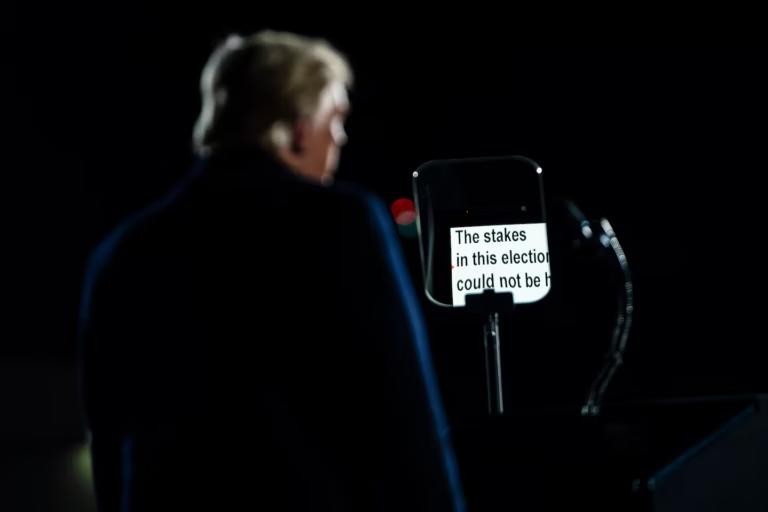
White House teleprompter operator placed on leave after betting on Trump speeches

White House teleprompter operator placed on leave after betting on Trump speeches

Politics — 2026-07-16 15:25:00 — www.washingtonpost.com

President Trump Places White House Teleprompter Operator on Leave Amid Betting Scandal

President Donald Trump has placed a White House teleprompter operator on unpaid leave after it was discovered the staffer was placing online bets related to the president’s public remarks. White House press secretary Karoline Leavitt confirmed on Thursday that the president took direct action to suspend the staffer and stated that the individual is cooperating with the Commodity Futures Trading Commission.

Direct Presidential Response

According to Leavitt, President Trump personally made the decision to put the staffer on leave following revelations about the betting activity. The administration’s response highlights the seriousness with which the president is treating the matter, ensuring compliance with federal regulations and ongoing investigations.

Compliance with Federal Oversight

Leavitt emphasized that the staffer is complying with the Commodity Futures Trading Commission, the federal agency responsible for regulating derivatives markets, including futures and options. This compliance suggests that the White House is cooperating with authorities to address any potential legal or ethical violations.

No Public False Claims or Disparagements

In this instance, the excerpt does not include any direct false claims or disparagements made by President Trump. Instead, it focuses on the president’s response to the staffer’s actions and the steps taken to address the situation.

Conclusion

President Trump’s decision to place a teleprompter operator on unpaid leave over online betting related to his public remarks demonstrates a swift response to potential ethical violations within the White House. The administration’s cooperation with the Commodity Futures Trading Commission underscores the importance of transparency and accountability in government operations. Readers should note that, in this case, the president’s actions were focused on upholding ethical standards rather than making public statements or claims.

Source article

Source: https://www.washingtonpost.com/politics/2026/07/16/white-house-teleprompter-operator-placed-leave-after-betting-trump-speeches/

What to expect from Trump’s address as he revisits 2020 election loss

What to expect from Trump’s address as he revisits 2020 election loss

PBS News Hour – Politics — 2026-07-16 17:55:00 — www.pbs.org

Trump to Make New Claims on 2020 Election, Despite Repeated Refutations by Courts and His Own Officials

President Trump is expected to make what he calls “really, really big news” about foreign interference in the 2020 presidential election, continuing his long-running effort to challenge the outcome of the race he lost. On Tuesday, Trump said, “It doesn’t get bigger, because without free and fair elections, you don’t have a country.” According to sources, he is likely to claim that China interfered in the 2020 election, pointing to thousands of pages of intelligence documents as supposed evidence.

Fact-Checking Trump’s Claims

Trump’s repeated assertions about widespread fraud and foreign interference in the 2020 election have been thoroughly rejected by courts, election officials, and independent assessments. In January 2021, a report from his own Director of National Intelligence stated, “There are no indications that any foreign actor attempted to alter any technical aspect of the voting process in the 2020 U.S. elections, including voter registration, casting ballots, vote tabulation, or reporting results.” The same assessment found that “China did not deploy interference efforts and considered, but did not deploy influence efforts intended to change the outcome of the U.S. presidential election.”

Trump’s own Attorney General, Bill Barr, told the January 6 Committee, “I saw absolutely zero basis for the allegations, but they were made in such a sensational way that they obviously were influencing a lot of people, members of the public, that there was this systemic corruption in the system and that their votes didn’t count, and that these machines controlled by somebody else were actually determining it, which was complete nonsense.”

Concerns from Election Officials

Election officials across the country have expressed concern that Trump’s continued falsehoods may undermine public confidence in upcoming elections. One Republican official in a swing state said the party should focus on issues like affordability, not voting machines from the 2020 election. Arizona’s secretary of state noted that the administration keeps losing court challenges over election administration and called the expected speech “another futile attempt to influence an area that the president and the executive branch has no influence over.”

Conclusion

Despite overwhelming evidence and repeated statements from his own administration refuting claims of widespread fraud or foreign interference in the 2020 election, President Trump continues to promote these falsehoods. As he prepares to make new claims in a prime-time address, election officials and fact-checkers remain vigilant, warning that such rhetoric threatens the integrity and public trust in the American electoral system.

Source article

Source: https://www.pbs.org/newshour/show/what-to-expect-from-trumps-address-as-he-revisits-2020-election-loss

Trump again makes unverifiable claims of noncitizen voting

Trump again makes unverifiable claims of noncitizen voting

NYT > U.S. > Politics — 2026-07-17 00:02:00 — www.nytimes.com

Trump Claims Hundreds of Thousands of Noncitizens Registered to Vote—States and Data Say Otherwise

President Trump and the Department of Homeland Security claimed on Thursday that they had uncovered a significant number of noncitizens registered to vote in four states, but offered no evidence to support their findings nor any description of their investigative process. Trump escalated his longstanding claims about noncitizen voting, stating that the Department of Homeland Security had found “approximately 278,000 noncitizens who are registered to vote in federal elections.” According to Trump, this figure was based on a document released by the White House from the Department of Homeland Security, which alleged that more than 250,000 noncitizens were registered in California, New Jersey, Nevada, and Pennsylvania.

Lack of Evidence and Immediate Pushback

The document provided by the administration did not explain how it arrived at such a large number and acknowledged that the four states in question do not use the SAVE system, a federal resource for verifying citizenship status. Without access to this system, it is unclear how the Department of Homeland Security could have produced its count using only public voter files.

Election officials in at least one state, Nevada, immediately rebuffed Trump’s claims. Data from the Nevada secretary of state’s office showed that out of 2.1 million active voters, only 138 did not provide a state driver’s license or Social Security number when registering. Nevada officials stated that there is no evidence of widespread noncitizen registration on its voter rolls, and those 138 voters may have registered with other valid forms of identification, such as tribal IDs. Cisco Aguilar, Nevada’s Democratic secretary of state, said he had received no notifications from DHS about any such threat.

Pattern of Inflated Claims and Fact-Checking

Trump’s evidence-free claims that noncitizens have voted in elections have been central to his political messaging and his push for the SAVE America Act, a federal voting bill that Democrats argue is designed to benefit Republicans. In the past, Republican state officials have released inflated numbers of alleged noncitizen voters, only to revise those numbers sharply downward after further review.

For example, Iowa initially estimated more than 2,100 potential noncitizens on its voter rolls, but after proper investigation, that number dropped to 277. Of those, only 35 noncitizens cast ballots that were counted in the 2024 general election out of more than 1.6 million ballots. The Center for Election Innovation and Research, a nonpartisan group, has noted that claims of large numbers of noncitizens on voter rolls are “revised significantly downward after proper investigation and scrutiny.”

Methodology in Question

The most recent analysis by DHS appears to rely on publicly available state voter records that are scrubbed of key identifying information for privacy reasons, such as driver’s license numbers. This method is widely recognized as unreliable and prone to inflating numbers. The administration itself has argued in court filings that access to unredacted voter records is necessary to avoid misidentifying duplicate names, a request that states have resisted to protect voter privacy and comply with state laws.

Conclusion

President Trump’s latest claims of widespread noncitizen voter registration lack substantiation and have been directly contradicted by state officials and available data. The pattern of making broad, unverified allegations about election integrity continues to draw criticism from both Democratic and Republican election officials, who emphasize that noncitizen voting remains extremely rare. As states and independent organizations continue to scrutinize these claims, the evidence consistently fails to support the president’s narrative.

Source article

Source: https://www.nytimes.com/2026/07/16/us/politics/trump-again-makes-unfounded-claims-of-noncitizen-voting.html

US hits more bridges in Iran in an expansion of its airstrike campaign

US hits more bridges in Iran in an expansion of its airstrike campaign

Donald Trump — 2026-07-16 23:26:00 — www.politico.com

Trump Threatens Strikes to Pressure Iran Over Strait of Hormuz

President Donald Trump had threatened strikes on infrastructure to pressure Tehran to ease its chokehold on the Strait of Hormuz, a critical waterway for global oil shipments. This statement highlights Trump’s willingness to escalate tensions in the region by targeting key assets in Iran, aiming to force a change in Iranian behavior regarding the strategic strait.

Trump’s Threats and Their Implications

Trump’s threat to strike infrastructure was intended as a show of force to compel Iran to relax its control over the Strait of Hormuz. This approach marked a significant escalation in rhetoric and policy, signaling a readiness to use military action to achieve U.S. objectives in the region.

Fact-Checking Trump’s Approach

The assertion that Trump threatened strikes is directly attributable to his administration’s posture at the time. Such threats were part of a broader strategy to pressure Iran through both economic sanctions and the possibility of military action. However, critics and analysts have often pointed out that these threats risked further destabilizing the region and potentially disrupting global oil supplies.

Conclusion

President Trump’s threat to strike Iranian infrastructure in response to Tehran’s actions in the Strait of Hormuz underscores his administration’s aggressive stance toward Iran. While intended to pressure Tehran, such threats also raised concerns about escalating conflict and the potential consequences for international stability. The episode remains a key example of Trump’s confrontational approach to foreign policy in the Middle East.

Source article

Source: https://www.politico.com/news/2026/07/17/us-hits-more-bridges-in-iran-in-an-expansion-of-its-airstrike-campaign-01002669

Five takeaways from Trump’s big elections speech

Five takeaways from Trump’s big elections speech

Administration News — 2026-07-16 22:38:00 — thehill.com

President Trump Pushes Election Fraud Claims in National Address

President Trump delivered an address to the nation on Thursday evening in which he sought to paint the state of U.S. election security as indefensible. In his remarks, Trump pushed for the passage of contentious legislation he favors and attempted to persuade more Americans to accept his widely debunked allegations of fraud in the electoral process.

Trump’s Position on Election Security

During his address, Trump described U.S. election security as inadequate, a characterization that contradicts repeated assurances from federal and state officials regarding the integrity of recent elections. By framing the system as “indefensible,” Trump aimed to justify his ongoing calls for legislative changes and to bolster support for his claims of widespread voter fraud.

Fact-Checking Trump’s Allegations

Trump’s allegations of election fraud have been widely debunked by independent fact-checkers and officials across the political spectrum. Despite numerous investigations and court rulings finding no evidence of widespread fraud, Trump continues to assert that the electoral process is compromised. His efforts to promote these claims have been a central part of his public messaging, even as they have been repeatedly discredited.

Push for Controversial Legislation

In addition to casting doubt on election security, Trump used his address to advocate for legislation that he claims would address these alleged vulnerabilities. The measures he supports have been described as contentious, with critics arguing they are unnecessary and could undermine voter access.

Conclusion

President Trump’s latest address underscores his ongoing campaign to question the legitimacy of U.S. elections and to push for legislative changes based on claims that have been thoroughly discredited. As Trump continues to advance these narratives, it remains essential for the public to rely on verified facts and the findings of nonpartisan experts regarding the security and integrity of the nation’s electoral system.

Source article

Source: https://thehill.com/homenews/administration/5973514-save-america-act-push/