Home Blog Page 29

Trump tries to undermine trust in elections, but documents don’t support his claims

Trump tries to undermine trust in elections, but documents don’t support his claims

PBS News Hour – Politics — 2026-07-17 17:55:00 — www.pbs.org

Trump Revives Debunked Election Claims in Prime-Time Address, Fact-Checks Show

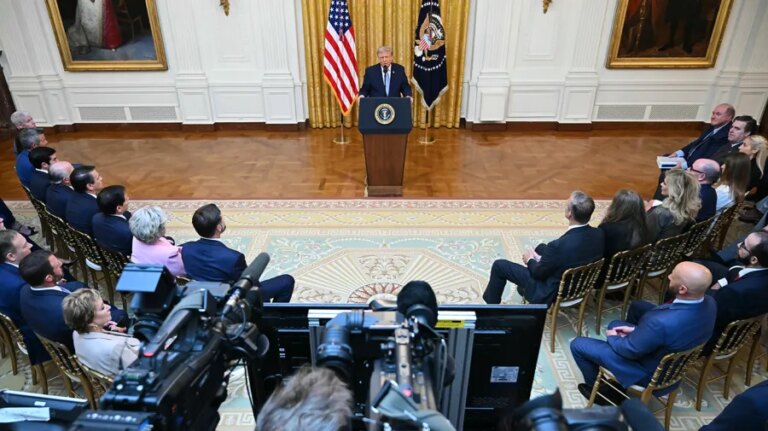
President Donald Trump used a recent prime-time address to revive a series of debunked claims about the integrity of American elections, painting a dire picture of U.S. election security and calling for more restrictive voting laws ahead of the November midterms.

False Claims About Foreign Interference

In his address, Trump announced the “immediate declassification and release of critical intelligence revealing shocking vulnerabilities in our election infrastructure.” He claimed, “The People’s Republic of China carried out what is believed to be the largest compromise of election data in history, resulting in China’s illicit acquisition of 220 million U.S. voter files.” However, a close examination of the White House’s own released documents tells a different story. The intelligence community discussed China’s attempts to potentially influence the 2020 election, but the documents present these as potential dangers, with no evidence that any attempts were successful. One declassified document explicitly states that publicly available voter registration information for six states was downloaded by China in 2022, well after the 2020 election.

David Becker, Executive Director of the Center for Election Innovation and Research, directly refuted Trump’s claims, stating, “The reality is, it wasn’t a hack.” He explained that voter lists in the United States are public and available for purchase or even free in some states.

Unfounded Allegations About Voting Machines

Trump also alleged that U.S. voting machines are “vulnerable and they’re easily compromised,” referencing a supposed CIA report about Venezuela’s Maduro regime rigging its own elections. However, fact-checks reveal that such efforts would only be possible if every step of the election process was under government control, which is not the case in the U.S. Released documents conclude that attempts to manipulate vote totals would not work in the American system, which relies on paper ballots and strict chain of custody protocols.

Exaggerated Numbers on Noncitizen Voters

Turning to immigration, Trump claimed, “According to the DHS review, state voter rolls and public records, they identified approximately 278,000 noncitizens who are registered to vote in federal elections.” The report did not explain how this number was reached, and Homeland Security Secretary Markwayne Mullin could not say how many, if any, of those people actually voted. Federal databases and screening tools used to identify noncitizens have been shown to frequently flag U.S. citizens in error, especially naturalized Americans. A federal judge recently blocked the Trump administration from using such data, noting it “haphazardly combined and repurposed the private information of millions of Americans, including citizenship data that they knew to be unreliable.”

Sowing Doubt Ahead of the Midterms

Despite repeated fact-checks and the lack of evidence supporting his claims, Trump continues to use false statements to sow doubt about the integrity of American elections. As the midterms approach, these claims appear designed to undermine public confidence and justify restrictive voting measures.

Conclusion

President Trump’s latest address repeats a pattern of making exaggerated and unsupported claims about election security, foreign interference, and noncitizen voting. Fact-checks and official documents consistently contradict his assertions, highlighting the importance of scrutinizing such statements as the nation prepares for another critical election cycle.

Source article

Source: https://www.pbs.org/newshour/show/trump-tries-to-undermine-trust-in-elections-but-documents-dont-support-his-claims

As Trump Scraps With Meloni, His Envoy to Italy Is at Sea

As Trump Scraps With Meloni, His Envoy to Italy Is at Sea

NYT > U.S. > Politics — 2026-07-17 23:01:00 — www.nytimes.com

President Trump Escalates Feud With Italian Prime Minister Meloni Amid Diplomatic Tensions

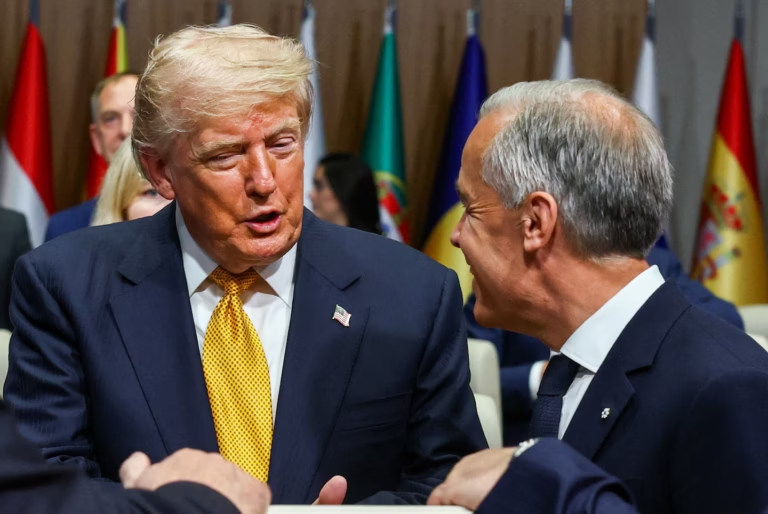
President Trump intensified his public standoff with Italian Prime Minister Giorgia Meloni, posting on social media that he needed to take out a “restraining order” against her. This came just two weeks after he claimed Meloni had “begged” him for a photo at a gathering of world leaders, further fueling the diplomatic spat between the United States and Italy.

Trump’s Attacks and Claims

Trump’s remarks about Meloni—first alleging she “begged” for a photo and then suggesting a “restraining order” was necessary—highlight his ongoing pattern of using social media to disparage foreign leaders and escalate personal disputes. These statements have drawn attention not only for their tone but also for their accuracy, as no independent evidence has surfaced to support Trump’s claim that Meloni “begged” for a photo.

Diplomatic Fallout

The feud between Trump and Meloni has been described as the worst public conflict between American and Italian leaders in living memory. Trump is reportedly furious over Italy’s decision not to support the war in Iran, while Meloni has pushed back, accusing Trump of picking a fight with the pope. The tensions have overshadowed the work of the U.S. ambassador to Italy, Tilman J. Fertitta, who has tried to maintain diplomatic relations amid the controversy.

Conclusion

President Trump’s recent statements about Prime Minister Meloni are part of a broader pattern of public attacks and questionable claims directed at foreign leaders. As the diplomatic rift continues, Trump’s rhetoric risks further straining the historically strong relationship between the United States and Italy. The episode underscores the impact of presidential statements on international relations and the importance of accuracy and restraint in diplomatic communications.

Source article

Source: https://www.nytimes.com/2026/07/18/world/europe/tilman-fertitta-superyacht-italy-ambassador.html

Trump calls for revocation of ABC, NBC licenses over speech snub

Trump calls for revocation of ABC, NBC licenses over speech snub

Donald Trump — 2026-07-16 20:47:00 — www.politico.com

Trump Accuses Networks of “Fraud” for Not Airing Election Security Address

President Donald Trump escalated his ongoing attacks on the media by claiming that television networks which did not broadcast his primetime address on election security had committed “fraud.” This accusation, made during a recent speech, marks another instance in which Trump has used charged language to disparage media organizations that do not provide him with the coverage he seeks.

Trump’s Claim of “Fraud”

According to the excerpt, Trump directly stated that networks declining to air his address on election security were guilty of “fraud.” This assertion is significant because “fraud” is a serious legal term, typically referring to deliberate deception for personal or financial gain. In this context, Trump used the term to describe an editorial decision—a move that does not meet the legal or commonly understood definition of fraud.

Fact-Checking the Accusation

There is no evidence to support the idea that a television network commits fraud by choosing not to air a presidential address. Editorial discretion is a fundamental aspect of press freedom in the United States. Networks regularly make decisions about which events to broadcast based on newsworthiness, audience interest, and programming schedules. Trump’s use of the word “fraud” in this context is an exaggeration and a mischaracterization of the networks’ actions.

Pattern of Attacks on the Media

This latest statement fits into a broader pattern of Trump’s rhetoric, in which he frequently attacks media outlets that he perceives as unfavorable or insufficiently supportive. By labeling their actions as “fraud,” Trump not only misstates the facts but also seeks to undermine public trust in independent journalism.

Conclusion

President Trump’s claim that networks committed “fraud” by not airing his election security address is unfounded and misrepresents the nature of editorial decisions. Such statements contribute to a climate of mistrust and confusion about the role of the media in American democracy. It is important for the public to recognize the difference between legitimate editorial choices and the serious legal implications of fraud, and to hold leaders accountable for the accuracy of their words.

Source article

Source: https://www.politico.com/news/2026/07/16/trump-calls-for-revocation-of-abc-nbc-licenses-over-speech-snub-01002580

Fact-checking the Trump administration’s count of 250,000 noncitizens on the voter rolls

Fact-checking the Trump administration’s count of 250,000 noncitizens on the voter rolls

PolitiFact – Rulings and Stories — 2026-07-17 16:10:00 — www.politifact.com

Trump Pushes Noncitizen Voting Claims Despite Lack of Evidence

President Donald Trump has once again spotlighted noncitizen voting as a major threat to the U.S. election system, despite years of evidence showing such cases are statistically rare and have no impact on election results. In a July 16 primetime address, Trump urged lawmakers to pass the SAVE America Act, which would require government-issued photo ID and documentary proof of citizenship to register to vote—a measure currently stalled in the Senate over concerns about voter disenfranchisement.

Alongside Trump’s address, the Department of Homeland Security released documents claiming that “over 250,000 non-citizens are illegally registered to vote in just the four states” of California, Pennsylvania, New Jersey, and Nevada. This figure was repeated by Homeland Security Secretary Markwayne Mullin, who stated, “We’ve identified 250,000 noncitizens registered to vote in just four states.”

However, voting experts and state officials have urged caution, noting that such numbers are often inflated due to database errors, mistaken identities, and outdated citizenship information. Historically, initial large estimates of noncitizen voters have dropped dramatically after thorough vetting. For example, Florida’s 2012 review started with 180,000 potential noncitizens but ultimately found only 85 after further investigation.

The data cited by Trump and Mullin does not indicate whether any of the identified noncitizens actually voted, nor does it show any impact on election outcomes. Trump’s rhetoric, however, gives the unsupported impression that noncitizen voting is widespread and influential. In reality, violations are “routinely investigated and prosecuted,” but there is “no evidence that noncitizen voting has ever been significant enough to impact an election’s outcome,” according to the Bipartisan Policy Center.

Officials from the states targeted by the DHS report have expressed skepticism. Nevada’s Secretary of State called the numbers “wildly speculative at best,” and Pennsylvania’s Secretary of State reiterated that noncitizen voting is “extremely rare across the country.”

In summary, Trump continues to promote the narrative of widespread noncitizen voting despite a lack of supporting evidence and repeated findings that such cases are rare and not impactful. The claims about 250,000 noncitizen voters remain unsubstantiated, and experts warn that the real numbers are likely much lower after proper review.

Source article

Source: https://www.politifact.com/article/2026/jul/17/Mullin-dhs-250000-noncitizen-voters-Trump/

5 things to know about Trump's election claims

5 things to know about Trump's election claims

Administration News — 2026-07-17 18:07:00 — thehill.com

President Trump Alleges Election System Vulnerabilities Without Evidence in Primetime Address

In a primetime address from the White House, President Trump alleged significant vulnerabilities in the American election system, raising concerns about potential foreign interference, particularly from China. However, the information he shared did not reveal any new details and failed to provide evidence that any election results from previous years were fraudulent.

During his remarks, President Trump pointed to newly declassified documents that he claimed suggest foreign adversaries could interfere with future elections. Despite these assertions, the address did not substantiate claims of past election fraud or present concrete proof of compromised results.

Fact-checking the president’s statements, the address largely reiterated previously made allegations without offering new or credible evidence. The president’s focus on foreign threats, especially from China, was not supported by documentation showing actual interference or fraud in past American elections.

Conclusion

President Trump’s latest address continued his pattern of casting doubt on the integrity of the U.S. election system without providing substantiated evidence. While he highlighted the potential for foreign interference, his claims about past election fraud remain unproven according to the information presented in his speech. This ongoing rhetoric underscores the importance of critically evaluating such statements and relying on verified facts when assessing the security and reliability of American elections.

Source article

Source: https://thehill.com/homenews/administration/5975599-trump-election-interference-claims-declassified-documents/

Trump wants to impose tariffs on Canada in retaliation for wildfire smoke

Trump wants to impose tariffs on Canada in retaliation for wildfire smoke

Politics — 2026-07-17 17:23:00 — www.washingtonpost.com

Trump Threatens Tariffs on Canada Over Wildfire Smoke, Blames Canadian Forest Management

President Donald Trump on Friday threatened to impose tariffs on Canada in retaliation for wildfire smoke drifting into the United States, raising questions about both the accuracy of his claims and his legal authority to take such action. In a post on Truth Social, Trump wrote, “We are holding Canada responsible for the fact that they are not properly maintaining their Forests, and Brush therein, and the United States is being unnecessarily invaded by filthy, polluted, and unhealthy air, the quality of which is dangerous, and totally unacceptable!”

Blaming Canada for Wildfire Smoke

Trump’s statement directly accuses Canada of failing to properly manage its forests and brush, asserting that this negligence is responsible for the wildfire smoke affecting air quality in the United States. He characterizes the air as “filthy, polluted, and unhealthy,” and claims it poses a danger to Americans.

Fact-Checking Trump’s Claims

Wildfire smoke from Canada has indeed affected air quality in parts of the United States, but Trump’s assertion that Canada is solely to blame for not “properly maintaining their Forests, and Brush” oversimplifies a complex environmental issue. Wildfires are influenced by a range of factors, including climate change, weather patterns, and natural cycles, not just forest management practices. Experts widely agree that while forest management can play a role in wildfire prevention, no single country can fully control the spread of wildfire smoke across borders, especially in the face of extreme weather events.

Legal Authority in Question

Trump’s threat to impose tariffs on Canada as punishment for wildfire smoke also raises legal questions. There is no clear precedent or legal mechanism for the United States to levy tariffs on another country over environmental factors like air pollution caused by wildfires. Trade tariffs are typically used in response to economic disputes, not environmental grievances.

Pattern of Exaggeration and Attacks

This episode fits a broader pattern in Trump’s public statements, where he has made exaggerated or misleading claims and directed blame at other countries or groups. By describing the air as “dangerous, and totally unacceptable,” Trump amplifies the rhetoric without acknowledging the scientific realities or the shared challenges of managing wildfires in a changing climate.

Conclusion

President Trump’s threat to impose tariffs on Canada over wildfire smoke, along with his claims about Canadian forest management, reflect a tendency to simplify complex issues and assign blame without regard for scientific consensus or legal limitations. As wildfire smoke continues to impact air quality, addressing the problem will require international cooperation and evidence-based policy, not unilateral threats or unfounded accusations.

Source article

Source: https://www.washingtonpost.com/politics/2026/07/17/trump-wants-impose-tariffs-canada-retaliation-wildfire-smoke/

Trump says these documents prove his false claims of election fraud. Here’s what they really say

Trump says these documents prove his false claims of election fraud. Here’s what they really say

PBS News Hour – Politics — 2026-07-17 18:08:00 — www.pbs.org

Trump’s Election Fraud Claims Refuted by Newly Released Documents

President Donald Trump, in a primetime address from the White House, claimed to reveal “shocking revelations” about the 2020 election, including allegations of Chinese meddling, a “deep state” cover-up, and widespread vulnerabilities in U.S. election systems. He asserted, “Americans were blatantly lied to about the security of our election infrastructure,” and described what he called the “largest compromise of election data in history,” alleging that China illicitly obtained 220 million U.S. voter files.

Fact-Check: No Evidence of Foreign Vote Manipulation

A review by The Associated Press of the documents released by Trump found no confirmation of these claims. The collection, which included declassified reports, investigation files, and intelligence analysis, was often so heavily redacted that findings were unclear. Where findings were available, they outlined vulnerabilities that have been well-documented for years, but did not provide evidence that China or any other foreign entity manipulated the vote in 2020 or any other year.

While it is established that China collects large volumes of data on Americans, there is no evidence that this information was used to influence or alter election outcomes. Public versions of voter files are widely available and legally bought and sold by campaigns and political parties. Intelligence community assessments after the 2020 election found no direct Chinese interference in voting, and the documents released do not refute that conclusion.

Noncitizen Voter Claims Lack Verification

Trump also touted a Department of Homeland Security investigation that he said identified approximately 278,000 noncitizens registered to vote in federal elections. However, the report did not allege that any of these individuals actually voted, and the data has not been verified. The database used to identify noncitizens has been criticized for errors, including misclassifying naturalized citizens, and a federal judge has barred its use over concerns of wrongful voter purges. Studies consistently find that noncitizen voting is extremely rare.

Russian Election Interference: Contradictory Claims

Trump has repeatedly criticized U.S. intelligence assessments that Russia interfered in the 2016 election to help him win. Yet, one declassified document from 2020 found Russia had tried the most to penetrate American election systems, but in an effort to defeat Joe Biden. The same document stated that China and Iran wanted Trump to lose, but only Russia was found to have engaged in targeting or manipulating election-related systems.

Election System Vulnerabilities and Trump’s Actions

Trump claimed the documents revealed “shocking vulnerabilities” in election infrastructure. While some reports did list breaches—mostly by Russia—these risks have been acknowledged for years and are mitigated by safeguards such as paper ballot backups and audits. The administration’s actions, including ousting members of a bipartisan federal election commission and cutting funding to the Cybersecurity and Infrastructure Security Agency, have raised concerns about the federal response to election security.

Conclusion: Claims Not Supported by Evidence

Despite Trump’s dramatic assertions, the documents released do not support his allegations of mass voter fraud or foreign manipulation of the 2020 election. The evidence continues to show that while vulnerabilities exist, there is no proof of widespread fraud or successful foreign interference in the outcome of U.S. elections. Trump’s claims remain unsubstantiated by the very materials he presented as proof.

Source article

Source: https://www.pbs.org/newshour/politics/trump-says-these-documents-prove-his-false-claims-of-election-fraud-heres-what-they-really-say

Trump promised evidence of election fraud. Experts say there was none

Trump promised evidence of election fraud. Experts say there was none

NPR Topics: Politics — 2026-07-17 15:19:00 — www.npr.org

Trump Warns of “Shocking Vulnerabilities” in U.S. Elections, But Experts Say Claims Are Misleading

In a primetime address Thursday, President Trump warned of “shocking vulnerabilities” in U.S. elections, raising concerns about the integrity of the nation’s voting systems. However, many election experts say much of Trump’s claims amount to old news and are not supported by evidence.

Trump’s Claims of Election Vulnerabilities

During his address, Trump asserted that the U.S. election system is rife with weaknesses that could be exploited, suggesting that the nation’s democratic process is at risk. He painted a dire picture of election security, implying widespread potential for fraud and manipulation.

Fact-Checking Trump’s Assertions

Election experts have repeatedly reviewed the types of claims Trump made in his address. According to these experts, many of the issues Trump described have been thoroughly investigated in the past and have not been found to pose the kind of systemic threat he suggests. For example, claims of widespread voter fraud have been debunked by numerous studies and bipartisan investigations, which have found that such incidents are exceedingly rare.

Recycling Discredited Claims

Much of the rhetoric in Trump’s speech echoes statements he has made in previous years, particularly following the 2020 election. Experts note that these claims have been fact-checked and found to be misleading or outright false. By repeating these assertions, Trump continues to cast doubt on the electoral process without presenting new evidence to support his warnings.

Conclusion: Experts Urge Caution Amid Unfounded Warnings

President Trump’s primetime warning about “shocking vulnerabilities” in U.S. elections has been met with skepticism from election experts, who emphasize that his claims are largely recycled and unsupported by credible evidence. As the nation prepares for future elections, it is crucial for public discourse to be grounded in verified facts rather than unfounded fears.

Source article

Source: https://www.npr.org/2026/07/17/nx-s1-5897446/trump-promised-evidence-of-election-fraud-experts-say-there-was-none

Trump has declared war on elections in the name of protecting them | Austin Sarat

Trump has declared war on elections in the name of protecting them | Austin Sarat

US politics | The Guardian — 2026-07-17 13:33:00 — www.theguardian.com

Trump Uses White House Address to Push Baseless Claims About Election Integrity

On Thursday night, Donald Trump used a primetime address from the White House’s East Room to once again cast doubt on the integrity of American elections. Unlike previous presidents who have reserved such speeches for moments of national crisis or to announce major policies, Trump’s address focused on rehashing his longstanding grievances about the 2020 presidential election and sowing distrust in the electoral process.

Persistent False Claims

During his speech, Trump claimed that the “election system is so broken and so vulnerable that no one can possibly defend it,” and outlined a series of federal actions to address supposed threats to election security. However, as noted in the excerpt, these threats are “in fact, nonexistent.” The New York Times has reported that “no evidence has ever emerged showing that vote counts have been manipulated or corrupted,” and that Trump’s repeated claims about vulnerabilities in voting machine technology remain unsubstantiated.

Trump’s history of making baseless allegations about rigged contests extends beyond presidential elections. After losing the Iowa caucuses in 2016, he accused Senator Ted Cruz of fraud and demanded a new election or the nullification of Cruz’s results. When he lost the popular vote in the 2016 general election, Trump asserted, without evidence, “I won the popular vote if you deduct the millions of people who voted illegally.”

Undermining Confidence in Elections

Trump’s relentless campaign to undermine confidence in elections has already had a measurable impact. According to a recent PBS/NPR/Marist poll cited in the excerpt, Americans’ confidence that their elections will be run fairly has dropped to its lowest point in years. The president’s repeated promotion of conspiracy theories and falsehoods about election integrity has contributed to this erosion of trust.

Conclusion

Trump’s use of the White House platform to amplify unfounded claims about election fraud marks a significant departure from the tradition of presidential addresses focused on uniting the nation or addressing genuine emergencies. Instead, his speech served to further undermine faith in American democracy, continuing a pattern of false statements and attacks on the electoral process. As the excerpt concludes, this ongoing campaign to sow doubt is both shameless and dangerous for the future of the country’s democratic institutions.

Source article

Source: https://www.theguardian.com/commentisfree/2026/jul/17/trump-speech-election-denialism

Trump cites national security to stop offshore wind development. Here’s what to know

Trump cites national security to stop offshore wind development. Here’s what to know

PBS News Hour – Politics — 2026-07-17 12:49:00 — www.pbs.org

Trump Administration’s Campaign Against Offshore Wind: National Security Claims Face Judicial and Expert Skepticism

President Donald Trump’s administration has aggressively moved to halt offshore wind development, repeatedly citing national security risks as the primary justification. Since late last year, the administration has stopped work on major projects and begun buying back leases, with Interior Secretary Doug Burgum pointing to a classified report from Defense Secretary Pete Hegseth as proof of the alleged threat.

Backdrop of Fossil Fuel Advocacy and Wind Turbine Opposition

These actions come in the context of Trump’s well-documented hostility toward wind turbines and his stated goal of achieving “energy dominance” through fossil fuels. Despite national laboratory estimates showing that offshore wind could generate more than enough electricity to meet the nation’s annual needs, the administration has prioritized fossil fuel expansion.

Fact-Checking the National Security Argument

The Trump administration’s claim that offshore wind poses new national security risks has been met with skepticism from both experts and the courts. While it is true that wind turbines can interfere with radar, this is not a new issue. The Pentagon has long reviewed wind farm plans and can restrict construction in sensitive areas. Technological upgrades to radar systems are available to mitigate these impacts, and thousands of turbines operate successfully in Europe and Asia.

Retired U.S. Navy Vice Adm. Dennis McGinn, who oversaw naval operations in the Pacific, stated there is no “showstopping national security issue” that would invalidate years of analysis supporting offshore wind. He accused the administration of exaggerating risks and costs to justify a pro-fossil fuel agenda, saying, “it doesn’t pass commonsense tests.” Federal judges reviewing the administration’s classified evidence allowed all five halted wind projects to resume, with Senior Judge Royce Lamberth expressing concern that the national security rationale may have been “pretextual,” masking other motives.

Judicial and Legislative Pushback

Courts have repeatedly found the administration’s national security arguments unconvincing. In one case, Judge Lamberth noted that the government failed to apply its newly discovered concerns specifically to the affected project and delayed action until after unrelated public criticism of offshore wind.

Democratic Senator Jack Reed, after a classified briefing, described the administration’s reasoning as unpersuasive and is pushing for legislation requiring thorough and timely analysis of wind project impacts. Reed noted that the administration “finds many ways to stop things it doesn’t like,” expecting continued opposition to wind energy.

Conclusion: Pattern of Exaggeration and Policy Obstruction

President Trump’s administration has consistently cited national security to justify halting offshore wind development, despite longstanding solutions to technical challenges and widespread expert disagreement. Courts and military professionals have questioned the validity and timing of these claims, suggesting they serve as a pretext for advancing fossil fuel interests and obstructing renewable energy. The ongoing legal and political battles highlight the administration’s pattern of exaggerating threats to justify controversial policy decisions.

Source article

Source: https://www.pbs.org/newshour/politics/trump-cites-national-security-to-stop-offshore-wind-development-heres-what-to-know