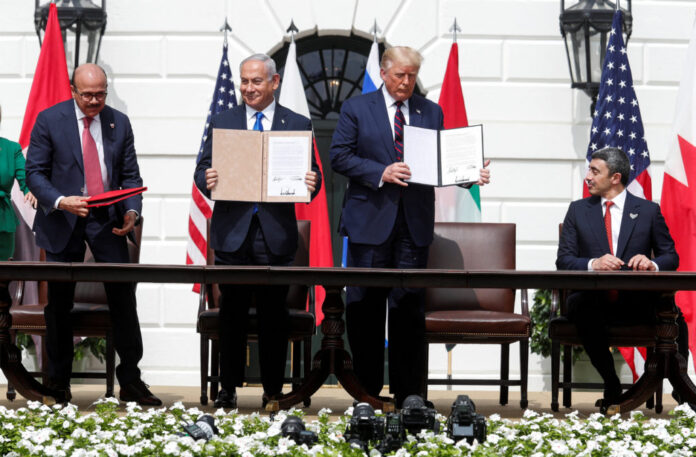

Trump says Iran deal should include additional countries joining Abraham Accords
PBS NewsHour – Politics — 2026-05-25 12:03:00 — www.pbs.org
Trump’s Iran Deal Proposal Tied to Abraham Accords Expansion Raises Eyebrows
WASHINGTON (AP) — President Donald Trump made headlines on Monday with a bold assertion that any future agreement with Iran should mandate the participation of several additional countries in the Abraham Accords, the U.S.-brokered agreements aimed at normalizing relations with Israel. In a social media post, Trump claimed that negotiations are “proceeding nicely” but insisted that expanded participation in the accords, first signed in 2020, is a prerequisite for any deal.
New Conditions for Iran Agreement
In his post, Trump specifically named Saudi Arabia and Qatar as countries that should “immediately” join the accords, followed by Pakistan, Turkey, Egypt, and Jordan. He stated, “after all the work done by the United States to try and pull this very complex puzzle together, it should be mandatory that all of these Countries, at a minimum, simultaneously, sign onto the Abraham Accords.”
However, Trump’s assertion raises questions about the feasibility and timing of such a requirement. Egypt and Jordan already have long-standing peace treaties with Israel, and their inclusion in the accords is somewhat redundant. Furthermore, the suggestion that even Iran could eventually sign on if an agreement is reached adds another layer of complexity to an already intricate diplomatic landscape.
Contradictions and Misstatements
Trump’s comments come amid ongoing negotiations regarding Iran’s nuclear program, yet the timeline for any potential deal remains unclear. Experts have pointed out that linking the Iran agreement to the Abraham Accords could complicate negotiations further. “The Abraham Accords were designed to foster cooperation among certain Arab states and Israel, but adding more countries to the mix could derail progress,” said Middle East analyst Michael Weiss.
Moreover, Trump’s claim that negotiations are “proceeding nicely” contradicts reports from various diplomatic sources indicating that talks have stalled. This inconsistency is not new for Trump, who has previously made sweeping claims about foreign policy successes that have not materialized. For instance, he has often touted the Abraham Accords as a monumental achievement, despite the fact that they have not led to widespread normalization of relations between Israel and its Arab neighbors.
Public Perception and Misinformation
Trump’s statements reflect a broader trend of misinformation that can influence public opinion and behavior. For example, his repeated claims about the success of the Abraham Accords have led many supporters to believe that peace in the Middle East is closer than it actually is. This perception can skew public understanding of the complexities involved in Middle Eastern diplomacy.
Conclusion
As Trump continues to navigate the intricate web of Middle Eastern politics, his recent statements regarding Iran and the Abraham Accords highlight both his ambitious vision and the potential pitfalls of his approach. With the stakes high and the timeline uncertain, the international community will be watching closely to see how these negotiations unfold. Trump’s insistence on expanding the Abraham Accords as a condition for any Iran deal may ultimately complicate rather than facilitate progress in a region fraught with tension.