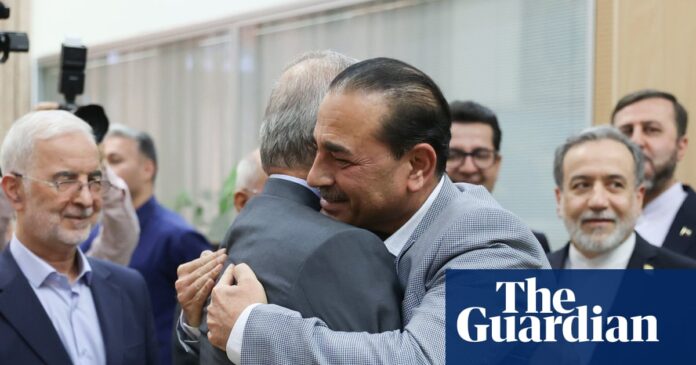

Trump says peace deal with Iran ‘largely negotiated’ with strait of Hormuz to open | US-Israel war on Iran
US politics | The Guardian — 2026-05-23 16:27:00 — www.theguardian.com
Trump Claims Peace Deal with Iran “Largely Negotiated” Amid Ongoing Tensions
Donald Trump announced on Saturday that a peace deal with Iran “has been largely negotiated,” following discussions with a Pakistani mediator, Gulf allies, and Israel. This statement, made on his social media platform, suggests a potential end to the conflict that began with the U.S. and Israel’s military actions in February. However, the accuracy of Trump’s claims and the context surrounding them raise significant questions.
Details of the Announcement
In his post, Trump stated that “final aspects and details” of a “Memorandum of Understanding” are still being discussed and “will be announced shortly.” He claimed that the strait of Hormuz would be reopened as part of the deal, asserting, “An Agreement has been largely negotiated, subject to finalization between the United States of America, the Islamic Republic of Iran, and the various other Countries.”
This announcement followed reports from a Pakistani source indicating that Iran and Pakistan had submitted a revised proposal to the U.S. to end the war and reopen the strait. A regional official familiar with the mediation efforts noted that the potential deal would include an official declaration of the war’s end, negotiations on Iran’s nuclear program, and an end to the U.S. blockade of Iranian ports.
Contradictory Statements and Ongoing Threats
Despite the optimistic tone of Trump’s announcement, he has continued to issue threats against Iran. In interviews with CBS and Axios, he stated he would only sign a deal “where we get everything we want,” and warned that if an agreement was not reached, the U.S. would resume military strikes against Iran. This contradictory stance raises concerns about the sincerity of his peace overtures.
Trump also claimed to have had discussions with numerous Middle Eastern leaders, including those from Saudi Arabia, the UAE, Qatar, Egypt, Jordan, and Bahrain, as well as Pakistan’s army chief and Turkey’s president. He mentioned a separate call with Israeli Prime Minister Bibi Netanyahu, stating, “which, likewise, went very well.” However, the details of these conversations remain unclear, and the actual progress of negotiations is still unverified.
Fact-Checking Trump’s Claims
While Trump’s assertion that a peace deal is “largely negotiated” may reflect ongoing discussions, it lacks substantial evidence. The Iranian government has made it clear that it will not compromise on its national rights, as stated by Iran’s top negotiator during a meeting with the Pakistani army chief. He emphasized that their intention was to draft a memorandum of understanding composed of 14 clauses, indicating that negotiations are still in the early stages.
Moreover, the Iranian proposal reportedly includes demands for the U.S. to end its blockade of Iranian ports, release billions of dollars in frozen assets, and compensate Iran for damages incurred during the war. It is unclear how many of these points are reflected in the memorandum Trump referenced.
Impact of Misinformation
Trump’s history of making misleading statements has influenced public perception and policy discussions. His previous claims regarding Iran’s nuclear capabilities and the effectiveness of sanctions have often been met with skepticism from experts and officials. For instance, his assertion that Iran was on the brink of developing nuclear weapons was contradicted by intelligence assessments that indicated otherwise.
The potential impact of Trump’s recent statements could further complicate U.S.-Iran relations, especially if they are perceived as empty promises or threats rather than genuine diplomatic efforts.
Conclusion
While Trump’s announcement of a “largely negotiated” peace deal with Iran may signal a shift in diplomatic efforts, the reality on the ground suggests a more complex situation. His contradictory statements and ongoing threats undermine the credibility of his claims. As negotiations continue, the international community will be watching closely to see if these discussions lead to a meaningful resolution or if they are merely another chapter in a long history of U.S.-Iran tensions.
Source: https://www.theguardian.com/world/2026/may/23/trump-ceasefire-iran-strait-of-hormuz