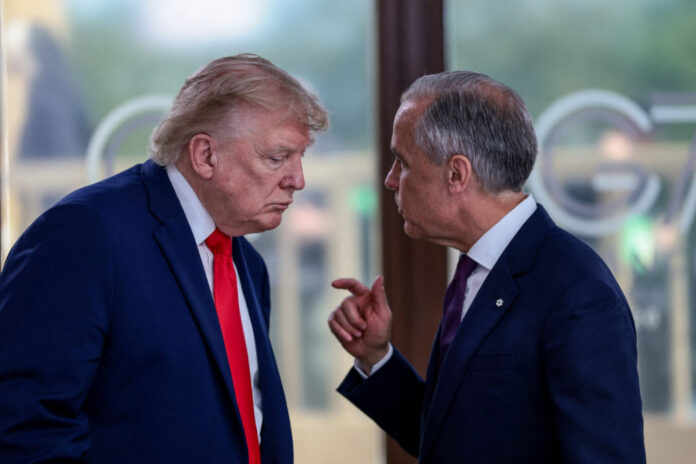

U.S. will ban dairy products, motorcycles and most alcoholic beverages from Canada
PBS News Hour – Politics — 2026-09-08 19:20:00 — www.pbs.org
Trump Escalates Trade War with Canada, Issues New Bans and Threats
U.S. President Donald Trump has sharply escalated the trade conflict with Canada, announcing a sweeping ban on Canadian dairy products, most alcoholic beverages, and motorcycles entering the United States. The move, set to take effect in three weeks, comes on the heels of Canada’s imposition of retaliatory tariffs on $20 billion in U.S. imports.
Trump’s Position and Actions
Trump directed the U.S. General Services Administration to block Canadian products from large, long-term U.S. government contracts, stating that Canadian goods would be ineligible until Canada allows “full and fair reciprocity” for American products. This marks a significant escalation in the ongoing trade dispute, with Trump charging that Canada has unfairly treated the American dairy, alcoholic beverage, and auto industries.
The president’s approach has included not only tariffs but also repeated inflammatory comments about making Canada the 51st U.S. state, a stance that has fueled anger and backlash across Canada. Trump’s administration has issued a series of threats and attacks portraying Canada as weak and dependent, further straining one of the world’s closest bilateral relationships.
Fact-Checking Trump’s Claims
Trump’s justification for the tariffs and bans centers on claims of unfair treatment by Canada, particularly in the dairy and auto sectors. However, the excerpt notes that the U.S. and Canada have long sparred over trade issues, including Canada’s protected dairy market and softwood lumber subsidies, but have remained close allies until the recent deterioration under Trump’s leadership.
The president’s repeated assertion that Canada is taking advantage of the U.S. is contradicted by the fact that more than 70% of Canadian exports still go to the United States, and Canada’s retaliatory tariffs were a direct response to U.S. actions. Canadian Prime Minister Mark Carney emphasized that Canada could not allow American goods to enter tariff-free while Canadian companies face U.S. tariffs, highlighting the reciprocal nature of the dispute.
Inflammatory Rhetoric and Its Impact
Trump’s repeated talk of making Canada the 51st state has been widely viewed as inflammatory and disrespectful, prompting strong responses from Canadian leaders and citizens. British Columbia Premier David Eby announced new signs at U.S. border crossings declaring, “Welcome to British Columbia, Canada. Strong, proud and will NEVER be the 51st state. Sorry!” This sentiment reflects a broader national resolve in Canada to resist Trump’s economic pressure and rhetoric.
Conclusion
President Trump’s aggressive trade actions and inflammatory statements have led to a rapid deterioration in U.S.-Canada relations, upending decades of close cooperation. His claims of unfair treatment and threats against Canada have been met with firm resistance and reciprocal measures from Canadian leaders. As both sides dig in, the outcome of this trade war will have lasting consequences for the North American partnership and could serve as a test of whether a smaller U.S. ally can withstand Trump’s economic and rhetorical pressure.