
Appeals court rules Trump can’t build White House ballroom without congressional approval
PBS News Hour – Politics — 2026-08-07 13:34:00 — www.pbs.org
Trump Dismisses Court Ruling Halting White House Ballroom, Insists Congressional Approval Not Needed
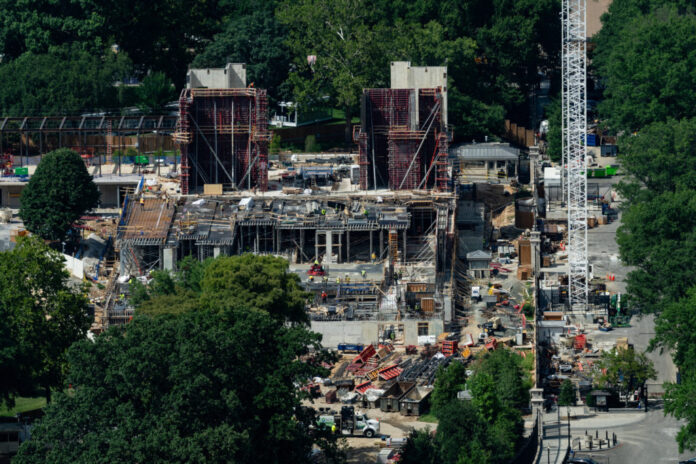
A federal appeals court has ordered President Donald Trump’s administration to stop construction of a $400 million, 90,000-square-foot ballroom at the White House, citing a lack of congressional approval. Trump, however, maintains that he does not need Congress’s authorization to proceed, calling the court’s decision “unjust” and vowing to appeal to the U.S. Supreme Court.
Trump’s Response and Claims
After the ruling, Trump took to social media to denounce the decision, quoting from a dissenting opinion by Judge Neomi Rao, whom he nominated. He described the planned facility as including bomb shelters, a hospital, medical facilities, and “Top Secret Military Facilities,” arguing that the project is essential for national security. Trump asserted, “The Military and Secret Service are viewing this horrendous, politically motivated, and unlawful ruling as a National Security threat to our Nation in that the entire Complex is being built for the protection of our Country and, additionally, all future Presidents.”
Trump further argued that congressional approval is unnecessary because, according to him, no public money is being used for the ballroom’s construction. He claims to have raised hundreds of millions of dollars from corporations, wealthy individuals, and himself to fund the project.
Contradictions and Congressional Oversight
Despite Trump’s insistence, the record shows that his administration requested $1 billion for the ballroom, which Congress refused in May. Additionally, Democrats have raised concerns that $350 million from a tax cuts law may have been redirected to the project—contradicting Trump’s assertion that no public funds are involved.
The appeals court’s 2-1 decision sided with historic preservationists who sued to stop the construction, emphasizing that only Congress can authorize such a significant alteration to the White House. The court wrote, “Whether or not a massive ballroom should be constructed is for Congress to decide and is not a matter for Executive self-help.”
National Security Justification Challenged
Trump and government lawyers have argued that the ballroom and associated underground facilities are necessary for national security, citing threats such as drones and missiles. However, attorneys for the preservation group countered that the absence of a White House ballroom does not constitute a national security emergency, a position the court found reasonable.
Conclusion
Trump’s public statements and the administration’s actions reveal a pattern of bypassing established legal and constitutional processes, particularly regarding congressional oversight of federal spending and construction. The court’s ruling underscores that even the president must adhere to the law and seek congressional approval for major changes to national landmarks. As the legal battle continues, the controversy highlights ongoing tensions between executive authority and the checks and balances fundamental to American democracy.