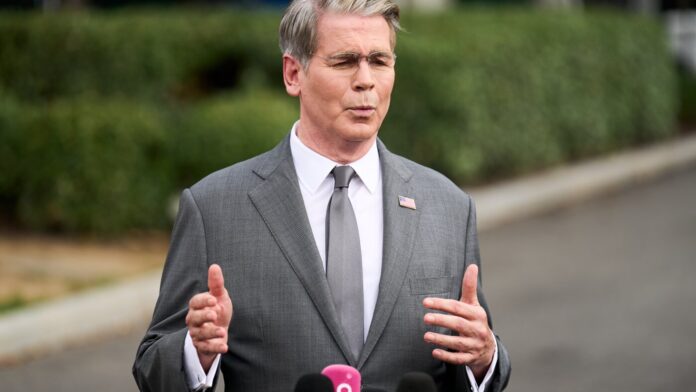

Treasury Secretary Scott Bessent to unveil new economic sanctions on Iran : NPR
NPR Topics: Politics — 2026-08-24 07:26:00 — www.npr.org
President Trump has labeled the upcoming round of economic sanctions on Iran as an “economic D-Day” and vowed to target other countries that provide an economic lifeline to Tehran. This escalation comes as Treasury Secretary Scott Bessent prepares to announce what he described as the “single greatest financial offensive ever” against Iran.
Sanctions Strategy and Global Impact
Trump’s rhetoric signals a shift in U.S. strategy, with a focus not only on businesses but also on governments that facilitate financial flows to Iran. The administration has already imposed extensive sanctions on Iran, some dating back nearly 50 years, and recently tightened penalties for entities helping Iran evade restrictions. A months-long U.S. naval blockade has further isolated Iran by cutting off most goods from the outside world.
In anticipation of the new measures, Iran’s currency, the Rial, has plunged to a record low. Trump’s pledge to go after countries aiding Iran appears aimed especially at China, which has historically purchased about 90 percent of Iran’s oil.
Skepticism Over Effectiveness
Despite Trump’s aggressive stance, some analysts question whether additional sanctions will have any real impact. Alan Eyre, a former U.S. diplomat involved in Iran nuclear negotiations, told NPR that the U.S. has already exhausted all meaningful sanction options, saying, “there are no new sanctions that are effective.”
Escalating Tensions and Humanitarian Concerns
Iran’s leadership has threatened “seismic” retaliation against any new U.S. economic warfare, warning Gulf states that participation in the sanctions could make them targets. Since the U.S. and Israel launched their war on Iran nearly six months ago, Iran has attacked U.S. bases and Gulf countries, resulting in injuries and fatalities. Iran has also threatened to further disrupt oil shipments through the Strait of Hormuz, a move that could worsen already historic disruptions to global energy supplies.
Meanwhile, ordinary Iranians continue to bear the brunt of the economic fallout. With inflation nearing 90 percent and the currency in freefall, many Iranians are forced to buy food on credit and struggle to afford basic necessities, including lifesaving medicines. The worsening economic situation has fueled public protests, which have been met with violent crackdowns.
Conclusion
President Trump’s declaration of an “economic D-Day” against Iran marks a dramatic escalation in U.S. policy, but experts question whether further sanctions can achieve their intended goals. As the administration doubles down on its hardline approach, the primary impact may be felt by ordinary Iranians already suffering under decades of economic pressure and conflict. The effectiveness and humanitarian consequences of this strategy remain deeply contested.